



Gray-rumped Treeswift
Hemiprocne longipennis
Silhouette: Sheatherius · PhyloPic
- KingdomAnimalia (Animals)
- PhylumChordata (Chordates)
- ClassAves (Birds)
- OrderApodiformes (Swifts and Hummingbirds)
- FamilyHemiprocnidae (Treeswifts)
- GenusHemiprocne (Treeswifts)
- SpeciesHemiprocne longipennis (Gray-rumped Treeswift)
About the Gray-rumped Treeswift
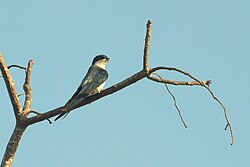
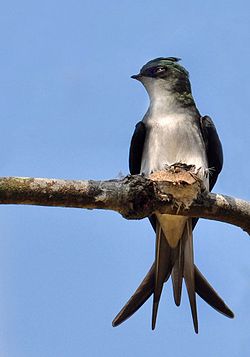
The grey-rumped treeswift (Hemiprocne longipennis) is a species of bird in the Hemiprocnidae family. Currently, four extant species are placed in the family. Like the other members of the Hemiprocnidae, this species is closely related to true swifts, but unlike true swifts, the treeswifts are arboreal, often seen perched on trees, high-tension power transmission lines, and pylons. When perched, the wing tips cross over the tail. This species is commonly found in peninsular Malaysia, but has an extremely large range; there is limited information about population trends.
Adult males have a distinct dark grey throat and chest contrasting with a white belly. Ear coverts are dull orange-red/chestnut-colored. Adult females lack the dull orange-red/chestnut coloration on the ear coverts. When perched, the wing tips cross over across the tail. Both sexes have a greenish sheen to the upper parts.
It is found in Brunei, Indonesia, Malaysia, Myanmar, the Philippines, Singapore, and Thailand. Its natural habitats are subtropical or tropical moist lowland forests, subtropical or tropical mangrove forests, and subtropical or tropical moist montane forests.
�... Wikipedia →
Recent sightings of Gray-rumped Treeswift in Bali Barat National Park
LIVEiNaturalist


Global Distribution
Warmer areas are where this animal is recorded most often.
Parks Where Found
| # | Park | Country | Daily sighting probability |
|---|---|---|---|
| 1 | Bali Barat National Park | 🇮🇩 Indonesia | |
| 2 | Gunung Leuser National Park | 🇮🇩 Indonesia | |
| 3 | Khao Luang National Park | 🇹🇭 Thailand | |
| 4 | Sepilok | 🇲🇾 Malaysia | |
| 5 | Way Kambas National Park | 🇮🇩 Indonesia | |
| 6 | Danum Valley Conservation Area | 🇲🇾 Malaysia | |
| 7 | Tangkoko Nature Reserve | 🇮🇩 Indonesia | |
| 8 | Kaeng Krachan National Park | 🇹🇭 Thailand | |
| 9 | Taman Negara National Park | 🇲🇾 Malaysia | |
| 10 | Khao Sok National Park | 🇹🇭 Thailand | |
| 11 | Tanjung Puting National Park | 🇮🇩 Indonesia | |
| 12 | Kinabalu Park | 🇲🇾 Malaysia | |
| 13 | Kinabatangan Wildlife Sanctuary | 🇲🇾 Malaysia | |
| 14 | Bako National Park | 🇲🇾 Malaysia | |
| 15 | Kerinci Seblat National Park | 🇮🇩 Indonesia |
Quick answers
What are the chances of seeing a Gray-rumped Treeswift in Bali Barat National Park?
About 30% of wildlife watchers report a Gray-rumped Treeswift sighting in Bali Barat National Park, based on 295 verified sightings from GBIF citizen-science data.
When is the best time to see Gray-rumped Treeswift in Bali Barat National Park?
May has the highest sighting rate for Gray-rumped Treeswift in Bali Barat National Park in our monthly data.