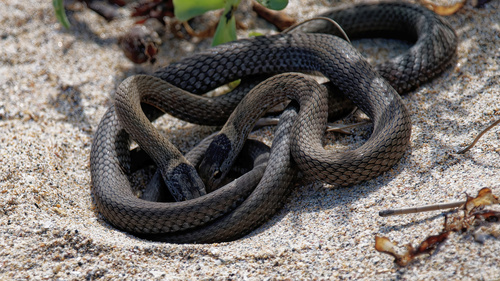

Mustard-bellied Snake
Drysdalia rhodogaster
Silhouette: SeismicShrimp · PhyloPic
- KingdomAnimalia (Animals)
- PhylumChordata (Chordates)
- ClassSquamata
- FamilyElapidae (Elapid Snakes)
- GenusDrysdalia (White-lipped Snakes)
- SpeciesDrysdalia rhodogaster (Mustard-bellied Snake)
About the Mustard-bellied Snake
Drysdalia rhodogaster, also known as the mustard-bellied snake or Blue Mountains crowned snake, is a species of venomous snake endemic to Australia. The specific epithet rhodogaster ("red-bellied") refers to body colouration.
The snake grows to an average of about 40 cm in length. The upper body is brown to grey, with a darker head and a yellow to orange band over the nape. The species is viviparous, with an average litter size of five. Its diet consists mainly of lizards.
The species' distribution is limited to south-eastern New South Wales. Wikipedia →
Recent sightings of Mustard-bellied Snake in Blue Mountains National Park
LIVEiNaturalistClosest Relatives at Blue Mountains National Park

 White-lipped Snake
Drysdalia coronoides

Red-bellied Black Snake
Pseudechis porphyriacus

Highlands Copperhead
Austrelaps ramsayi

 Eastern Tiger Snake
Notechis scutatus

Eastern Brown Snake
Pseudonaja textilis

Small-eyed Snake
Cryptophis nigrescens

Common Death Adder
Acanthophis antarcticus

Broad-headed Snake
Hoplocephalus bungaroides

Yellow-faced Whipsnake
Demansia psammophis

Golden Crowned Snake
Cacophis squamulosus

Bandy Bandy
Vermicella annulata

Red-naped Snake
Furina diadema
Global Distribution
Warmer areas are where this animal is recorded most often.
Parks Where Found
| # | Park | Country | Daily sighting probability |
|---|---|---|---|
| 1 | Blue Mountains National Park | 🇦🇺 Australia | |
| 2 | Royal National Park | 🇦🇺 Australia |
Quick answers
What are the chances of seeing a Mustard-bellied Snake in Blue Mountains National Park?
About 20% of wildlife watchers report a Mustard-bellied Snake sighting in Blue Mountains National Park, based on 51 verified sightings from GBIF citizen-science data.
When is the best time to see Mustard-bellied Snake in Blue Mountains National Park?
March has the highest sighting rate for Mustard-bellied Snake in Blue Mountains National Park in our monthly data.