

Yellow-faced Whipsnake
Demansia psammophis
Silhouette: SeismicShrimp · PhyloPic
- KingdomAnimalia (Animals)
- PhylumChordata (Chordates)
- ClassSquamata
- FamilyElapidae (Elapid Snakes)
- GenusDemansia (Whipsnakes)
- SpeciesDemansia psammophis (Yellow-faced Whipsnake)
About the Yellow-faced Whipsnake
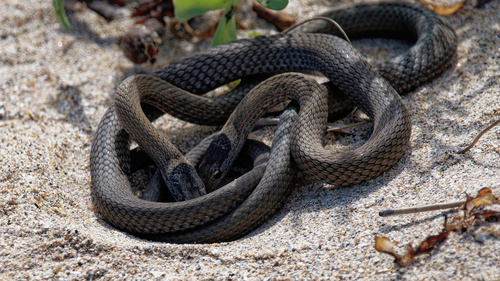
The yellow-faced whip snake (Demansia psammophis) is a species of venomous snake in the family Elapidae, a family containing many dangerous snakes. D. psammophis is endemic to Australia, found throughout the continent in a variety of habitats from coastal fringes to interior arid scrubland.
The yellow-faced whip snake is part of the genus Demansia, a group of venomous snakes in the family Elapidae. This genus is composed of whip snakes, characterized by their large eyes and whip-like tail. The genus Demansia is commonly found in the Southern hemisphere around Australia and equatorial countries such as Papua New Guinea. 15 species are assigned to the genus Demansia.
D. psammophis is a thin snake with a narrow head. It grows up to a total length (tail included) of 1 m (39 in), averaging around 80 cm (31 in), females being slightly smaller than males. Characterized by its narrow yellowish head, pale ring around the eyes, and a dark marking curving along the upper lip, D. psammophis becomes distinguishable from other Demansia snakes. Juveniles can be distinguished as a white-edged dark line is seen across the snout. The large prominent eyes surrounded by... Wikipedia →
Recent sightings of Yellow-faced Whipsnake in Blue Mountains National Park
LIVEiNaturalistClosest Relatives at Blue Mountains National Park

 Red-bellied Black Snake
Pseudechis porphyriacus

Highlands Copperhead
Austrelaps ramsayi

 Eastern Tiger Snake
Notechis scutatus
Mustard-bellied Snake
Drysdalia rhodogaster

Eastern Brown Snake
Pseudonaja textilis

Small-eyed Snake
Cryptophis nigrescens

Common Death Adder
Acanthophis antarcticus

Broad-headed Snake
Hoplocephalus bungaroides

Golden Crowned Snake
Cacophis squamulosus

Bandy Bandy
Vermicella annulata

Red-naped Snake
Furina diadema

White-lipped Snake
Drysdalia coronoides
Global Distribution
Warmer areas are where this animal is recorded most often.
Parks Where Found
| # | Park | Country | Daily sighting probability |
|---|---|---|---|
| 1 | Royal National Park | 🇦🇺 Australia | |
| 2 | Springbrook National Park | 🇦🇺 Australia | |
| 3 | Blue Mountains National Park | 🇦🇺 Australia | |
| 4 | Lamington National Park | 🇦🇺 Australia | |
| 5 | Noosa National Park | 🇦🇺 Australia |
Quick answers
What are the chances of seeing a Yellow-faced Whipsnake in Blue Mountains National Park?
About 10% of wildlife watchers report a Yellow-faced Whipsnake sighting in Blue Mountains National Park, based on 32 verified sightings from GBIF citizen-science data.
When is the best time to see Yellow-faced Whipsnake in Blue Mountains National Park?
February has the highest sighting rate for Yellow-faced Whipsnake in Blue Mountains National Park in our monthly data.