


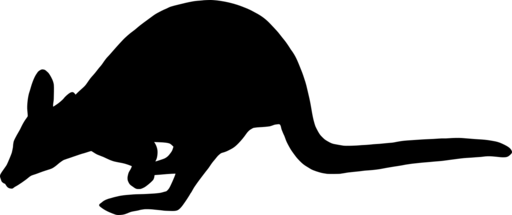
Red-necked Wallaby
Notamacropus rufogriseus
Silhouette: Kawinwit Kittipalawattanapol · PhyloPic
- KingdomAnimalia (Animals)
- PhylumChordata (Chordates)
- ClassMammalia (Mammals)
- OrderDiprotodontia (Kangaroos, Possums, Wombats, and Allies)
- FamilyMacropodidae (Kangaroos, Wallabies and Allies)
- GenusNotamacropus (Typical Wallabies)
- SpeciesNotamacropus rufogriseus (Red-necked Wallaby)
About the Red-necked Wallaby
The red-necked wallaby or Bennett's wallaby (Notamacropus rufogriseus) is a medium-sized macropod marsupial (wallaby), common in the more temperate and fertile parts of eastern Australia, including Tasmania. Red-necked wallabies have been introduced to several other countries, including New Zealand, the United Kingdom (in England and Scotland), Ireland, the Isle of Man, France and Germany.
Red-necked wallabies are distinguished by their black nose and paws, white stripe on the upper lip, and grizzled medium grey coat with a reddish wash across the shoulders. They can weigh 13.8 to 18.6 kilograms (30 to 41 lb) and attain a head-body length of 90 centimetres (35 in), although males are generally bigger than females. Red-necked wallabies are very similar in appearance to the black-striped wallaby (Notamacropus dorsalis), the only difference being that red-necked wallabies are larger, lack a black stripe down the back, and have softer fur. Red-necked wallabies may live up to nine years.
Red-necked wallabies are found in coastal scrub and sclerophyll forest throughout coastal and highland eastern Australia, from Bundaberg, Queensland, to the... Wikipedia →
Recent sightings of Red-necked Wallaby in Blue Mountains National Park
LIVEiNaturalistClosest Relatives at Blue Mountains National Park

 Eastern Grey Kangaroo
Macropus giganteus

 Swamp Wallaby
Wallabia bicolor

 Wallaroo
Macropus robustus

 Brush-tailed Rock-wallaby
Petrogale penicillata

Parma Wallaby
Macropus parma

 Common Wombat
Vombatus ursinus

 Common Brushtail
Trichosurus vulpecula

 Common Ringtail Possum
Pseudocheirus peregrinus

 Greater Glider
Petauroides volans

 Koala
Phascolarctos cinereus

 Sugar Glider
Petaurus breviceps

 Eastern Pygmy Possum
Cercartetus nanus
Global Distribution
Warmer areas are where this animal is recorded most often.
Parks Where Found
| # | Park | Country | Daily sighting probability |
|---|---|---|---|
| 1 | Freycinet National Park | 🇦🇺 Australia | |
| 2 | Cradle Mountain-Lake St Clair National Park | 🇦🇺 Australia | |
| 3 | Maria Island National Park | 🇦🇺 Australia | |
| 4 | Kosciuszko National Park | 🇦🇺 Australia | |
| 5 | Grampians National Park | 🇦🇺 Australia | |
| 6 | Lamington National Park | 🇦🇺 Australia | |
| 7 | Booderee National Park | 🇦🇺 Australia | |
| 8 | Blue Mountains National Park | 🇦🇺 Australia | |
| 9 | Springbrook National Park | 🇦🇺 Australia | |
| 10 | Great Otway National Park | 🇦🇺 Australia | |
| 11 | Wadden Sea National Park | 🇩🇪 Germany |
Quick answers
What are the chances of seeing a Red-necked Wallaby in Blue Mountains National Park?
About 20% of wildlife watchers report a Red-necked Wallaby sighting in Blue Mountains National Park, based on 121 verified sightings from GBIF citizen-science data.
When is the best time to see Red-necked Wallaby in Blue Mountains National Park?
May has the highest sighting rate for Red-necked Wallaby in Blue Mountains National Park in our monthly data.