
Dwarf Glass Frog
Teratohyla spinosa
Silhouette: Dmitry Bogdanov (vectorized by T. Michael Keesey) · PhyloPic
- KingdomAnimalia (Animals)
- PhylumChordata (Chordates)
- ClassAmphibia (Amphibians)
- OrderAnura (Frogs and Toads)
- FamilyCentrolenidae (Glass Frogs)
- GenusTeratohyla
- SpeciesTeratohyla spinosa (Dwarf Glass Frog)
About the Dwarf Glass Frog
Teratohyla spinosa (common name: spiny Cochran frog) is a species of frog in the family Centrolenidae. It is found in the Pacific lowlands of northern and central Ecuador and western Colombia, northward on the Pacific slopes Panama and Costa Rica, as well as on the Caribbean slopes of Costa Rica, Nicaragua, and Honduras.
Teratohyla spinosa are small, green frogs with large, protuberant eyes. Males grow to a snout–vent length of 18–20 mm (0.71–0.79 in) and females to 20–23 mm (0.79–0.91 in). Tadpoles are 16 mm (0.63 in) in length when metamorphosing. Adult males have an exposed spine at the base of the thumb.
Males call throughout the wet season (May–October) from the low vegetation surrounding small streams. Females lay 18–25 eggs on the underside of vegetation in a single layer of loose jelly. Larvae develop in streams. Teratohyla spinosa inhabits lowland primary humid lowland forests at elevations between 20 and 800 m (66 and 2,625 ft) above sea level. It is found along streams in the low vegetation. Its habitat is threatened by deforestation, although the species is not considered threatened in view of its wide distribution and presumed... Wikipedia →
Recent sightings of Dwarf Glass Frog in Braulio Carrillo National Park
LIVEiNaturalistClosest Relatives at Braulio Carrillo National Park

 Chiriqui Glass Frog
Teratohyla pulverata

Ghost Glass Frog
Sachatamia ilex

Emerald Glass Frog
Espadarana prosoblepon

 Reticulated Glass Frog
Hyalinobatrachium valerioi
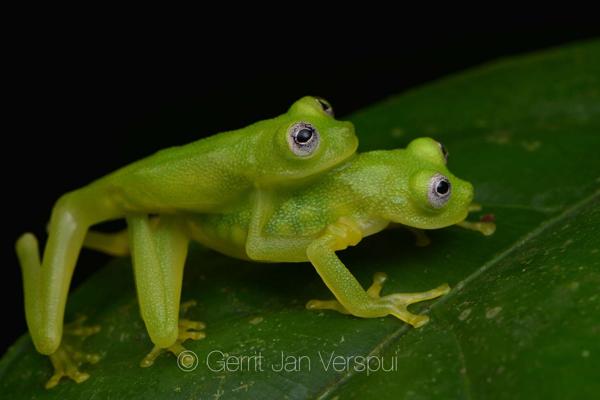
Diane's Bare-hearted Glass Frog
Hyalinobatrachium dianae

Fleischmann's Glass Frog
Hyalinobatrachium fleischmanni

Yellow-flecked Glassfrog
Sachatamia albomaculata

Green-striped Glass Frog
Hyalinobatrachium talamancae

Grainy Cochran Frog
Cochranella granulosa

 Strawberry Poison-dart Frog
Oophaga pumilio

Green and Black Dart-poison Frog
Dendrobates auratus

 Red-eyed Treefrog
Agalychnis callidryas
Global Distribution
Warmer areas are where this animal is recorded most often.
Parks Where Found
| # | Park | Country | Daily sighting probability |
|---|---|---|---|
| 1 | Braulio Carrillo National Park | 🇨🇷 Costa Rica | |
| 2 | Tenorio Volcano National Park | 🇨🇷 Costa Rica | |
| 3 | Soberanía National Park | 🇵🇦 Panama | |
| 4 | Utría National Natural Park | 🇨🇴 Colombia | |
| 5 | Marino Ballena National Park | 🇨🇷 Costa Rica | |
| 6 | Cahuita National Park | 🇨🇷 Costa Rica | |
| 7 | Arenal Volcano National Park | 🇨🇷 Costa Rica | |
| 8 | Chirripó National Park | 🇨🇷 Costa Rica | |
| 9 | Corcovado National Park | 🇨🇷 Costa Rica | |
| 10 | Tapantí-Macizo de la Muerte National Park | 🇨🇷 Costa Rica | |
| 11 | Monteverde Cloud Forest Reserve | 🇨🇷 Costa Rica |
Quick answers
What are the chances of seeing a Dwarf Glass Frog in Braulio Carrillo National Park?
About 20% of wildlife watchers report a Dwarf Glass Frog sighting in Braulio Carrillo National Park, based on 19 verified sightings from GBIF citizen-science data.
When is the best time to see Dwarf Glass Frog in Braulio Carrillo National Park?
December has the highest sighting rate for Dwarf Glass Frog in Braulio Carrillo National Park in our monthly data.