


Hart's Fruit-eating Bat
Enchisthenes hartii
Silhouette: Roberto Díaz Sibaja · PhyloPic
- KingdomAnimalia (Animals)
- PhylumChordata (Chordates)
- ClassMammalia (Mammals)
- OrderChiroptera (Bats)
- FamilyPhyllostomidae (New World Leaf-nosed Bats)
- GenusEnchisthenes
- SpeciesEnchisthenes hartii (Hart's Fruit-eating Bat)
About the Hart's Fruit-eating Bat
The velvety fruit-eating bat (Enchisthenes hartii), also known as Hart's little fruit bat, is a species of bat in the family Phyllostomidae. It is the only species within the genus Enchisthenes. It is found in Central America, Mexico, the United States, and northern South America.
It was described as a new species in 1892 by British zoologist Oldfield Thomas. Thomas initially placed it in the genus Artibeus, with the scientific name Artibeus hartii. The eponym for the species name "hartii" is J. H. Hart, who provided the holotype to Thomas. Hart was the superintendent of the Botanic Gardens in Trinidad, which is the type locality.
The genus Enchisthenes was described in 1908 by Danish mammalogist Knud Andersen. He noted that Enchisthenes was closely related to Artibeus, and designated A. hartii as the type species and the only member of the genus. Though the opinion of the taxonomic validity of Enchisthenes has varied since its description, it has most recently been recognized as a valid monotypic genus.
Its fur is nearly black in color, and its face has a few faint lines that are paler in color. It has a forearm length of 36–41 mm (1.4... Wikipedia →
Recent sightings of Hart's Fruit-eating Bat in Braulio Carrillo National Park
LIVEiNaturalistClosest Relatives at Braulio Carrillo National Park

 White Bat
Ectophylla alba

Vampire Bat
Desmodus rotundus

 Jamaican Fruit-eating Bat
Artibeus jamaicensis

Striped Yellow-eared Bat
Vampyriscus nymphaea

Northern Little Yellow-eared Bat
Vampyressa thyone

Northern Stripe-headed Round-eared Bat
Tonatia bakeri

pale spear-nosed bat
Phyllostomus discolor
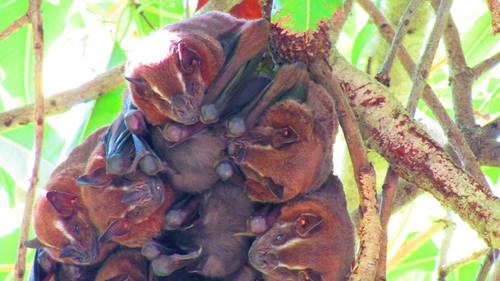
Great Fruit-eating Bat
Artibeus lituratus

MacConnell's bat
Mesophylla macconnelli

White-throated Round-eared Bat
Lophostoma silvicola

Heller's Broad-nosed Bat
Platyrrhinus helleri
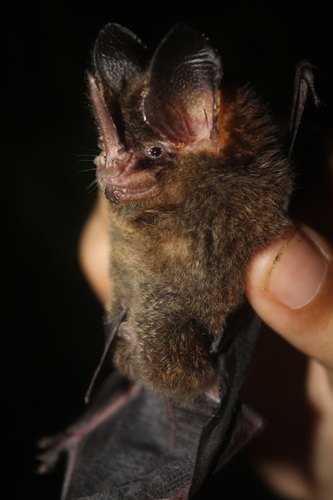
Keenan's Hairy-nosed Bat
Gardnerycteris keenani
Global Distribution
Warmer areas are where this animal is recorded most often.
Parks Where Found
| # | Park | Country | Daily sighting probability |
|---|---|---|---|
| 1 | El Triunfo | 🇲🇽 Mexico | |
| 2 | Braulio Carrillo National Park | 🇨🇷 Costa Rica | |
| 3 | Farallones de Cali National Natural Park | 🇨🇴 Colombia | |
| 4 | Manu National Park | 🇵🇪 Peru |