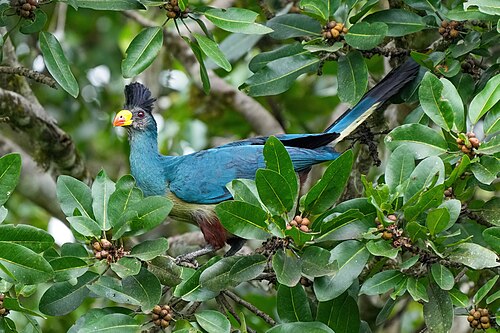



Great Blue Turaco
Corythaeola cristata
Silhouette: Kai Caspar · PhyloPic
- KingdomAnimalia (Animals)
- PhylumChordata (Chordates)
- ClassAves (Birds)
- OrderMusophagiformes (Turacos)
- FamilyMusophagidae (Turacos)
- GenusCorythaeola
- SpeciesCorythaeola cristata (Great Blue Turaco)
About the Great Blue Turaco
The great blue turaco (Corythaeola cristata) is a bird species of the family Musophagidae. At 70–76 cm (28–30 in) in length, it is the largest species of turaco. It has predominantly grey-blue plumage with an upright blue-black crest around 10 cm (3.9 in) high. The male and female have similar plumage. It is widespread throughout the African tropical rainforest.
French ornithologist Louis Pierre Vieillot described the great blue turaco as Musophaga cristata in 1816, before German ornithologist Ferdinand Heine placed it in its own genus in 1860. The great blue turaco is the sole member of the subfamily Corythaeolinae within the turaco family. Its closest relatives are the go-away birds and plantain eaters of the genus Crinifer. The common ancestor of both diverged from the ancestor of all other turaco species.
"Great blue turaco" has been designated the official common name by the International Ornithologists' Union (IOC). It is also called the blue plantain eater. The species ranges from Guinea in the west, and east across the sub-Saharan nations to the Imatong Mountains in South Sudan; it also occurs in Uganda, Rwanda, Tanzania and western... Wikipedia →
Recent sightings of Great Blue Turaco in Bwindi Impenetrable National Park
LIVEiNaturalistClosest Relatives at Bwindi Impenetrable National Park


Global Distribution
Warmer areas are where this animal is recorded most often.
Parks Where Found
| # | Park | Country | Daily sighting probability |
|---|---|---|---|
| 1 | Kibale National Park | 🇺🇬 Uganda | |
| 2 | Semuliki National Park | 🇺🇬 Uganda | |
| 3 | Bwindi Impenetrable National Park | 🇺🇬 Uganda | |
| 4 | Nyungwe National Park | 🇷🇼 Rwanda | |
| 5 | Virunga National Park | 🇨🇩 Democratic Republic of the Congo | |
| 6 | Queen Elizabeth National Park | 🇺🇬 Uganda | |
| 7 | Murchison Falls National Park | 🇺🇬 Uganda | |
| 8 | Lake Mburo National Park | 🇺🇬 Uganda | |
| 9 | Kidepo Valley National Park | 🇺🇬 Uganda | |
| 10 | Volcanoes National Park | 🇷🇼 Rwanda |
Quick answers
What are the chances of seeing a Great Blue Turaco in Bwindi Impenetrable National Park?
About 40% of wildlife watchers report a Great Blue Turaco sighting in Bwindi Impenetrable National Park, based on 891 verified sightings from GBIF citizen-science data.
When is the best time to see Great Blue Turaco in Bwindi Impenetrable National Park?
March has the highest sighting rate for Great Blue Turaco in Bwindi Impenetrable National Park in our monthly data.