


Blue Whale
Balaenoptera musculus
- KingdomAnimalia (Animals)
- PhylumChordata (Chordates)
- ClassMammalia (Mammals)
- OrderCetacea
- FamilyBalaenopteridae (Rorquals)
- GenusBalaenoptera
- SpeciesBalaenoptera musculus (Blue Whale)
About the Blue Whale
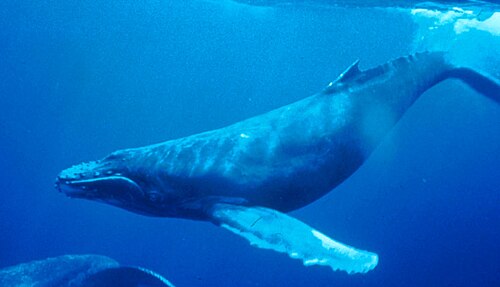
The blue whale (Balaenoptera musculus) is a species of baleen whale and the largest marine mammal in the rorqual family Balaenopteridae. Reaching a maximum confirmed length of 29.9–30.5 m (98–100 ft) and weighing up to 190–200 t (190–200 long tons; 210–220 short tons), it is the largest animal known to have ever existed. The blue whale's long and slender body can be of various shades of greyish-blue on its upper surface and somewhat lighter underneath. Four subspecies are recognized: B. m. musculus in the North Atlantic and North Pacific, B. m. intermedia in the Southern Ocean, B. m. brevicauda (the pygmy blue whale) in the Indian Ocean and South Pacific Ocean, and B. m. indica in the Northern Indian Ocean. There is a population in the waters off Chile that may constitute a fifth subspecies.
In general, blue whale populations migrate between their summer feeding areas near the poles and their winter breeding grounds near the tropics. There is also evidence of year-round residencies, and partial or age- and sex-based migration. Blue whales are filter feeders; their diet consists almost exclusively of krill. They are generally solitary or gather in small groups, and have no well-defined social structure other than mother–calf bonds. Blue whales vocalize, with a fundamental frequency ranging from 8 to 25 Hz; their vocalizations may vary by region, season, behavior, and time of day.
The blue whale was abundant in nearly all the Earth's oceans until the end of the 19th century. It was hunted almost to the point of extinction by whalers until the International Whaling Commission banned all blue whale hunting in 1966. The International Union for Conservation of Nature has listed blue whales as endangered as of 2018. Blue whales continue to face numerous man-made threats such as ship strikes, pollution, ocean noise, and climate change. Wikipedia →
Closest Relatives at Cabo Pulmo National Park


Global Distribution
Where this species is recorded worldwide. Restricted to human observations from 2019 onwards — the same kind of record and the same period the probabilities on this page are built from, so collar-tracking studies, camera-trap arrays and museum specimens are excluded. Around Santa Rosa that removes 5,924 GPS fixes from a handful of tagged jaguars.
where this species is recorded (GBIF density — it tracks where observers go, not how likely a sighting is) · parks where it occurs — tap a pin for the sighting probability there
Parks Where Found
| # | Park | Country | Daily sighting probability |
|---|---|---|---|
| 1 | Bahía de Loreto National Park | 🇲🇽 Mexico | |
| 2 | Channel Islands National Park | 🇺🇸 United States | |
| 3 | Galápagos Islands | 🇪🇨 Ecuador | |
| 4 | Cabo Pulmo National Park | 🇲🇽 Mexico | |
| 5 | El Vizcaíno Biosphere Reserve | 🇲🇽 Mexico |