

Hairy-legged Vampire Bat
Diphylla ecaudata
Silhouette: Roberto Díaz Sibaja · PhyloPic
- KingdomAnimalia (Animals)
- PhylumChordata (Chordates)
- ClassMammalia (Mammals)
- OrderChiroptera (Bats)
- FamilyPhyllostomidae (New World Leaf-nosed Bats)
- GenusDiphylla
- SpeciesDiphylla ecaudata (Hairy-legged Vampire Bat)
About the Hairy-legged Vampire Bat
The hairy-legged vampire bat (Diphylla ecaudata) is one of three extant species of vampire bats. It mainly feeds on the blood of wild birds, but can also feed both on domestic birds and humans. This vampire bat lives mainly in tropical and subtropical forestlands of South America, Central America, and southern Mexico. It is the sole member of the genus Diphylla.
It was described by German biologist Johann Baptist von Spix in 1823. Spix first encountered the species in Brazil. Spix coined the genus name Diphylla (from Latin dis 'double' and phyllon 'leaf') and the species name ecaudata (from Latin e 'without' and caudatus 'tail').
The two recognized subspecies are: Diphylla ecaudata centralis is found from western Panama to Mexico. A single specimen was taken in an abandoned railroad tunnel near Comstock, Val Verde County, Texas, in 1967, well outside the taxon's recognized range.
Diphylla ecaudata ecaudata is found from Brazil and eastern Peru to eastern Panama. It is similar in appearance to the common vampire bat. It differs, however, in its broad, short ears; padless, short thumb; and large, shiny eyes.
It also has more teeth than... Wikipedia →
Recent sightings of Hairy-legged Vampire Bat in Calakmul Biosphere Reserve
LIVEiNaturalistClosest Relatives at Calakmul Biosphere Reserve

 Jamaican Fruit-eating Bat
Artibeus jamaicensis

 Big-eared Woolly Bat
Chrotopterus auritus

Pygmy Fruit Eating Bat
Artibeus phaeotis

 wrinkle-faced bat
Centurio senex
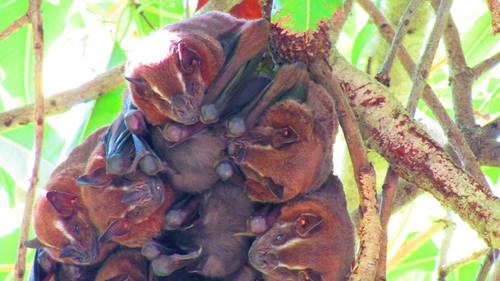
Great Fruit-eating Bat
Artibeus lituratus

Cozumelan Golden Bat
Mimon cozumelae

Vampire Bat
Desmodus rotundus

Yellow-throated Big-eared Bat
Lampronycteris brachyotis

Sowell’s Short-tailed Bat
Carollia sowelli

spectral bat
Vampyrum spectrum

 fringe-lipped bat
Trachops cirrhosus

Schmidts's big-eared bat
Micronycteris schmidtorum
Global Distribution
Warmer areas are where this animal is recorded most often.
Parks Where Found
| # | Park | Country | Daily sighting probability |
|---|---|---|---|
| 1 | La Tigra National Park | 🇭🇳 Honduras | |
| 2 | Calakmul Biosphere Reserve | 🇲🇽 Mexico |