

spectral bat
Vampyrum spectrum
Silhouette: Roberto Díaz Sibaja · PhyloPic
- KingdomAnimalia (Animals)
- PhylumChordata (Chordates)
- ClassMammalia (Mammals)
- OrderChiroptera (Bats)
- FamilyPhyllostomidae (New World Leaf-nosed Bats)
- GenusVampyrum
- SpeciesVampyrum spectrum (spectral bat)
About the spectral bat
The spectral bat (Vampyrum spectrum), also called the great false vampire bat, great spectral bat, American false vampire bat or Linnaeus's false vampire bat, is a large, carnivorous leaf-nosed bat found in Mexico, Central America, and South America. It is the only member of the genus Vampyrum; its closest living relative is the big-eared woolly bat. It is the largest bat species in the New World, as well as the largest carnivorous bat: its wingspan is 0.7–1.0 m (2.3–3.3 ft). It has a robust skull and teeth, with which it delivers a powerful bite to kill its prey. Birds are frequent prey items, though it may also consume rodents, insects, and other bats.
Unlike the majority of bat species, it is monogamous. Colonies consist of an adult male and female and their offspring. The adult male will bring food back to the roost to provision the adult female and their offspring. Colonies generally roost in tree hollows, though individuals may roost in caves. Due to habitat destruction and its low population density, it is listed as a near-threatened species by the International Union for Conservation of Nature (IUCN).
Contrary to its latin name, the spectral bat does not feed on blood. This activity has been observed in Vampire bats (Desmodontinae). Wikipedia →
Recent sightings of spectral bat in Calakmul Biosphere Reserve
LIVEiNaturalistClosest Relatives at Calakmul Biosphere Reserve

 Jamaican Fruit-eating Bat
Artibeus jamaicensis

 Big-eared Woolly Bat
Chrotopterus auritus

Pygmy Fruit Eating Bat
Artibeus phaeotis

 wrinkle-faced bat
Centurio senex
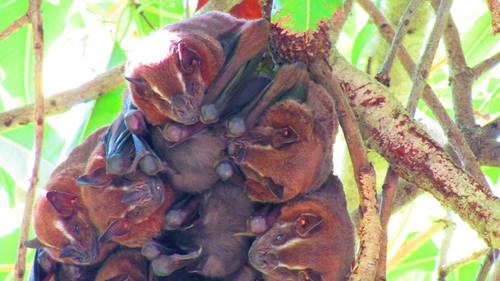
Great Fruit-eating Bat
Artibeus lituratus

Cozumelan Golden Bat
Mimon cozumelae

Vampire Bat
Desmodus rotundus

Yellow-throated Big-eared Bat
Lampronycteris brachyotis

Hairy-legged Vampire Bat
Diphylla ecaudata

Sowell’s Short-tailed Bat
Carollia sowelli

 fringe-lipped bat
Trachops cirrhosus

Schmidts's big-eared bat
Micronycteris schmidtorum
Global Distribution
Warmer areas are where this animal is recorded most often.
Parks Where Found
| # | Park | Country | Daily sighting probability |
|---|---|---|---|
| 1 | Calakmul Biosphere Reserve | 🇲🇽 Mexico |
More parks will be added in future updates.