

wrinkle-faced bat
Centurio senex
Silhouette: Roberto Díaz Sibaja · PhyloPic
- KingdomAnimalia (Animals)
- PhylumChordata (Chordates)
- ClassMammalia (Mammals)
- OrderChiroptera (Bats)
- FamilyPhyllostomidae (New World Leaf-nosed Bats)
- GenusCenturio
- SpeciesCenturio senex (wrinkle-faced bat)
About the wrinkle-faced bat
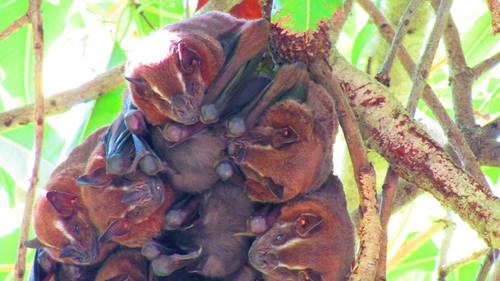
The wrinkle-faced bat (Centurio senex) is a species of bat in the family Phyllostomidae and the only identified member of the genus Centurio. This bat is found in various countries in and around Central America. It eats fruit but is not classified within the fruit bats, and is instead classified as a leaf-nosed bat even though it does not have a leaf nose. It has an unusually shaped skull which is thought to allow it to eat a wider range of foods than other bats.
Centurio senex is tail-less, medium-sized, and generally has a pelage of a drab brown to yellowish-brown color. It weighs around 17g. Its face is hairless and is covered by convoluted outgrowths of skin (hence the name wrinkle-faced). These skin flaps are more pronounced in males than females. Males also possess a skin mask that can be used to cover their face. The wrinkle-faced bat has storage pouches in its mouth to allow it to store fruit. C. senex subsp. greenhalli differs from the more common C. senex subsp. senex by being larger and in having a more domed braincase, better developed sagittal crest, and relatively shorter maxillary toothrow. Their skulls are extremely short and wide, which is thought... Wikipedia →
Recent sightings of wrinkle-faced bat in Calakmul Biosphere Reserve
LIVEiNaturalistClosest Relatives at Calakmul Biosphere Reserve

 Jamaican Fruit-eating Bat
Artibeus jamaicensis

 Big-eared Woolly Bat
Chrotopterus auritus

Pygmy Fruit Eating Bat
Artibeus phaeotis
Great Fruit-eating Bat
Artibeus lituratus

 Cozumelan Golden Bat
Mimon cozumelae

Vampire Bat
Desmodus rotundus

Yellow-throated Big-eared Bat
Lampronycteris brachyotis

Hairy-legged Vampire Bat
Diphylla ecaudata

Sowell’s Short-tailed Bat
Carollia sowelli

spectral bat
Vampyrum spectrum

 fringe-lipped bat
Trachops cirrhosus

Schmidts's big-eared bat
Micronycteris schmidtorum
Global Distribution
Warmer areas are where this animal is recorded most often.
Parks Where Found
| # | Park | Country | Daily sighting probability |
|---|---|---|---|
| 1 | Calakmul Biosphere Reserve | 🇲🇽 Mexico | |
| 2 | Monteverde Cloud Forest Reserve | 🇨🇷 Costa Rica | |
| 3 | Celaque National Park | 🇭🇳 Honduras | |
| 4 | Main Ridge Forest Reserve | 🇹🇹 Trinidad and Tobago | |
| 5 | Braulio Carrillo National Park | 🇨🇷 Costa Rica | |
| 6 | Ría Lagartos Biosphere Reserve | 🇲🇽 Mexico | |
| 7 | Arrecifes de Cozumel National Park | 🇲🇽 Mexico |
Quick answers
What are the chances of seeing a wrinkle-faced bat in Calakmul Biosphere Reserve?
About 10% of wildlife watchers report a wrinkle-faced bat sighting in Calakmul Biosphere Reserve, based on 9 verified sightings from GBIF citizen-science data.
When is the best time to see wrinkle-faced bat in Calakmul Biosphere Reserve?
November has the highest sighting rate for wrinkle-faced bat in Calakmul Biosphere Reserve in our monthly data.