


Centralian Bluetongue
Tiliqua multifasciata
- KingdomAnimalia (Animals)
- PhylumChordata (Chordates)
- ClassSquamata
- FamilyScincidae (Skinks)
- GenusTiliqua (Bluetongues)
- SpeciesTiliqua multifasciata (Centralian Bluetongue)
About the Centralian Bluetongue
The Centralian blue-tongued skink or Centralian blue-tongue (Tiliqua multifasciata) is a species of skink, occurring predominantly in the far north-west corner of New South Wales, Australia. It is one of six species belonging to the genus Tiliqua; the blue-tongued skinks and the shinglebacks. This species of reptile classifies as a lizard.
The Centralian blue-tongue is of a very robust build, short body and slender tail, and is among the largest 1% of species in the family Scincidae. Both the forelimb and hindlimb have five digits. The skink is predominantly pale brown to grey in colour with a series of nine or more orange-brown bands along the length of the body and tail. These darker coloured bands are much wider than the paler grey-brown interspaces but are at their narrowest along the mid-dorsal region of the skink. There is a distinguishing black stripe surrounding the eye and extending to just above the ear, and upper-hind areas of limbs are also black. The skink is pale cream to white on the underside.
The geographical distribution of the blue-tongued skink lies throughout the far north-west corner of New South Wales and South... Wikipedia →
Closest Relatives at Cape Range

Lined Firetail Skink
Morethia ruficauda

Plain Ctenotus
Ctenotus inornatus
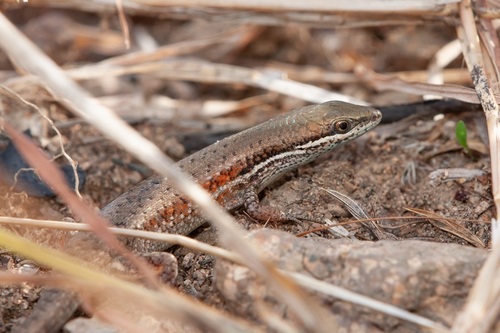
Shaded-litter Rainbow Skink
Carlia munda
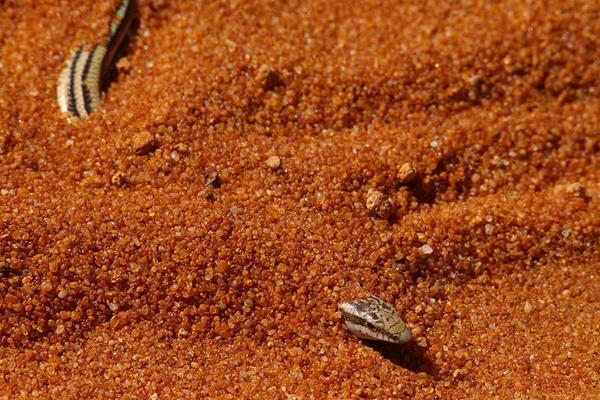
Keeled Slider
Lerista planiventralis

Callose-palmed Shining-skink
Cryptoblepharus plagiocephalus

Blunt-tailed West Coast Slider
Lerista praepedita

Leopard Ctenotus
Ctenotus pantherinus
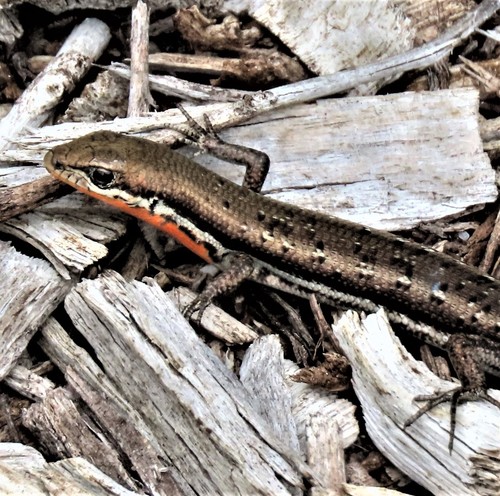
West Coast Morethia Skink
Morethia lineoocellata
Cape Range Slider
Lerista allochira
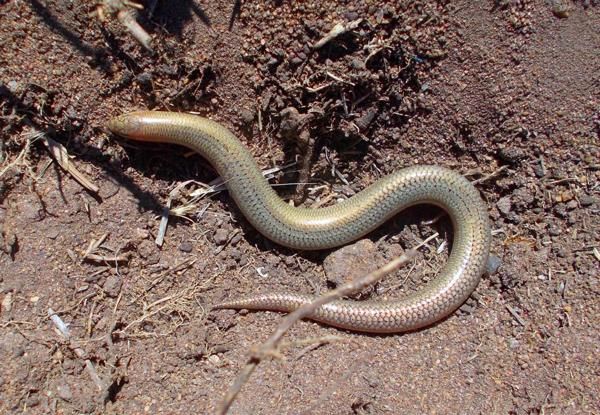
Northern Dotted-line Robust Slider
Lerista miopus
Global Distribution
Where this species is recorded worldwide. Restricted to human observations from 2019 onwards — the same kind of record and the same period the probabilities on this page are built from, so collar-tracking studies, camera-trap arrays and museum specimens are excluded. Around Santa Rosa that removes 5,924 GPS fixes from a handful of tagged jaguars.
where this species is recorded (GBIF density — it tracks where observers go, not how likely a sighting is) · parks where it occurs — tap a pin for the sighting probability there
Parks Where Found
| # | Park | Country | Daily sighting probability |
|---|---|---|---|
| 1 | Uluru-Kata Tjuta National Park | 🇦🇺 Australia | |
| 2 | Ningaloo Marine Park | 🇦🇺 Australia | |
| 3 | Cape Range | 🇦🇺 Australia |