
Leopard Ctenotus
Ctenotus pantherinus
- KingdomAnimalia (Animals)
- PhylumChordata (Chordates)
- ClassSquamata
- FamilyScincidae (Skinks)
- GenusCtenotus (Ctenotus Skinks)
- SpeciesCtenotus pantherinus (Leopard Ctenotus)
About the Leopard Ctenotus
Ctenotus pantherinus, commonly known as the leopard ctenotus, is a species of skink endemic to central and western Australia. Its conservation status is currently classified as Least Concern. They are a brown/grey lizard with a tail almost equal to its body length, with short, four stubby legs of similar length, ending in clawed feet with five digits. Yellow/white spots with a black/brown outline begin behind the head and extend to the tip of the tail. Some adult leopard ctenotus have white/yellow stripes on the side of the tail, starting at the hind leg. The underbelly is a pale white/yellow colour.
Leopard ctenotus are one of the largest and fastest growing Ctenotus species in Australia. They grow more during winter than other Ctenotus species and are active during all seasons. Males tend to grow at a slightly faster rate than females, and juveniles born in autumn grow faster over winter than those born in the summer months.
Ctenotus pantherinus is endemic to Australia and has been found in the semi- arid and arid regions of Western Australia, Northern Territory, Queensland, New South Wales and South Australia. Ctenotus... Wikipedia →
Closest Relatives at Cape Range

Plain Ctenotus
Ctenotus inornatus

Lined Firetail Skink
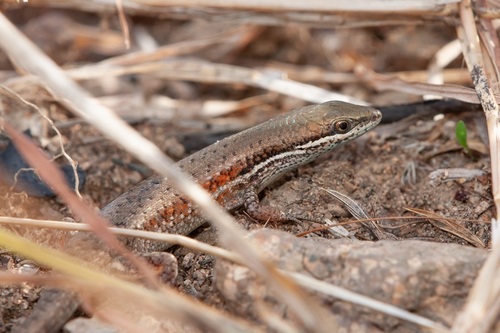
Morethia ruficauda
Shaded-litter Rainbow Skink
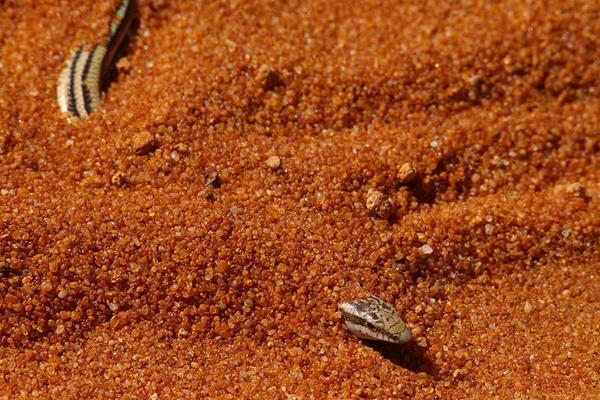
Carlia munda
Keeled Slider
Lerista planiventralis

Callose-palmed Shining-skink
Cryptoblepharus plagiocephalus

Blunt-tailed West Coast Slider
Lerista praepedita

Centralian Bluetongue
Tiliqua multifasciata
West Coast Morethia Skink
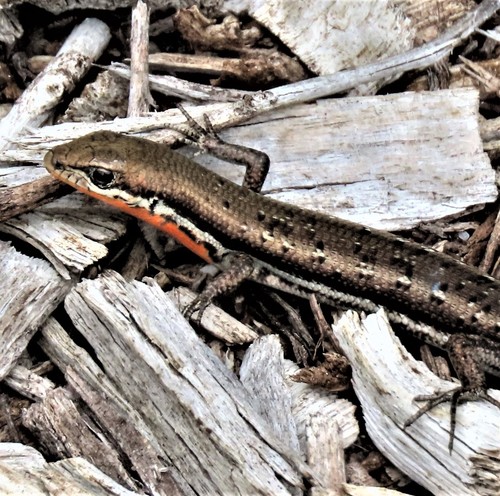
Morethia lineoocellata
Cape Range Slider
Lerista allochira
Northern Dotted-line Robust Slider
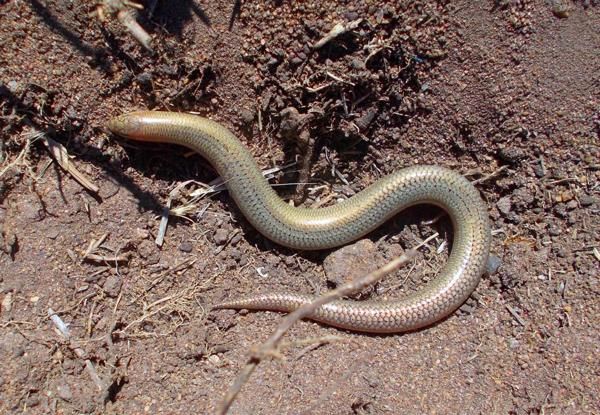
Lerista miopus
Global Distribution
Where this species is recorded worldwide. Restricted to human observations from 2019 onwards — the same kind of record and the same period the probabilities on this page are built from, so collar-tracking studies, camera-trap arrays and museum specimens are excluded. Around Santa Rosa that removes 5,924 GPS fixes from a handful of tagged jaguars.
where this species is recorded (GBIF density — it tracks where observers go, not how likely a sighting is) · parks where it occurs — tap a pin for the sighting probability there
Parks Where Found
| # | Park | Country | Daily sighting probability |
|---|---|---|---|
| 1 | Uluru-Kata Tjuta National Park | 🇦🇺 Australia | |
| 2 | Cape Range | 🇦🇺 Australia | |
| 3 | Ningaloo Marine Park | 🇦🇺 Australia |