


Common Prickly Gecko
Heteronotia binoei
- KingdomAnimalia (Animals)
- PhylumChordata (Chordates)
- ClassSquamata
- FamilyGekkonidae (Typical Geckos)
- GenusHeteronotia (Prickly Geckos)
- SpeciesHeteronotia binoei (Common Prickly Gecko)
About the Common Prickly Gecko
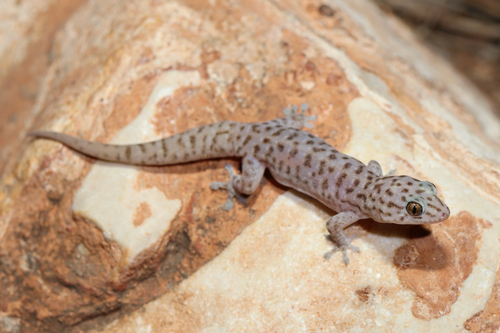
Heteronotia binoei, known commonly as Bynoe's gecko, is a species of lizard in the family Gekkonidae, and is endemic to Australia. One of the continent's least-habitat-specific geckos, it occurs naturally across much of the country, and has also established in areas where it does not occur normally, such as urban Perth, Western Australia. It is dark brown to reddish-brown, depending on the colour of the ground upon which it lives (to which it adapts for camouflaging), as well as irregular light bands with dark edges along its back.
Bynoe's gecko is one of a small number of vertebrate species that are known to reproduce by parthenogenesis, another reptilian example being the mourning gecko (Lepidodactylus lugubris) of Southeast Asia and Oceania islands (not Australia or New Zealand).
The specific name, binoei, is in honour of British naturalist Benjamin Bynoe (1803–1865), who was a naval surgeon aboard HMS Beagle with Charles Darwin. The Bynoe's gecko is a slender, long-tailed species which may grow to a total length (including tail) of 11–12 cm (4.3–4.7 in). It is covered with small scales which appear to be rough, but are soft to touch. It has slim... Wikipedia →
Closest Relatives at Cape Range


Global Distribution
Where this species is recorded worldwide. Restricted to human observations from 2019 onwards — the same kind of record and the same period the probabilities on this page are built from, so collar-tracking studies, camera-trap arrays and museum specimens are excluded. Around Santa Rosa that removes 5,924 GPS fixes from a handful of tagged jaguars.
where this species is recorded (GBIF density — it tracks where observers go, not how likely a sighting is) · parks where it occurs — tap a pin for the sighting probability there
Parks Where Found
| # | Park | Country | Daily sighting probability |
|---|---|---|---|
| 1 | Litchfield National Park | 🇦🇺 Australia | |
| 2 | Flinders Ranges National Park | 🇦🇺 Australia | |
| 3 | Kakadu National Park | 🇦🇺 Australia | |
| 4 | Cape Range | 🇦🇺 Australia | |
| 5 | Ningaloo Marine Park | 🇦🇺 Australia | |
| 6 | Uluru-Kata Tjuta National Park | 🇦🇺 Australia | |
| 7 | Nitmiluk National Park | 🇦🇺 Australia |
Quick answers
What are the chances of seeing a Common Prickly Gecko in Cape Range?
About 30% of wildlife watchers report a Common Prickly Gecko sighting in Cape Range, based on 9 verified sightings from GBIF citizen-science data.
When is the best time to see Common Prickly Gecko in Cape Range?
May has the highest sighting rate for Common Prickly Gecko in Cape Range in our monthly data.