
Western Brown Snake
Pseudonaja mengdeni
- KingdomAnimalia (Animals)
- PhylumChordata (Chordates)
- ClassSquamata
- FamilyElapidae (Elapid Snakes)
- GenusPseudonaja (Australian Brown Snakes)
- SpeciesPseudonaja mengdeni (Western Brown Snake)
About the Western Brown Snake
The western brown snake (Pseudonaja mengdeni) is commonly known as Mengden's brown snake, and alternatively, gwardar. Pseudonaja mengdeni is endemic to Australia. It is highly variable in colour and patterns and is a highly dangerous elapid whose bite can cause severe symptoms resulting in death. It is one of the three species originally classified as Pseudonaja nuchalis along with P. aspidorhyncha, and P. nuchalis.
Previously the western brown snake was considered a 'morph' form of Pseudonaja nuchalis, recent genetic studies have proven it to be genetically unique. It is estimated that Pseudonaja nuchalis could include in excess of 10 different species. Although currently there have been 8 species chromosomeally identified species these include: P. aspidorhyncha, P. mengdeni, P. imperator, P. acutirostris, P. gowi, P. carinata, P. kellyi and P. nuchalis.
Pseudonaja mengdeni grows up to a total length of 2m with an average length 1.2m. It has slender body and narrow head. Mengden's brown snake is highly variable in colour and patterns, ranging from light brown to almost black. However it has two distinct forms 'Orange with black head' or 'Pale head... Wikipedia →
Closest Relatives at Cape Range
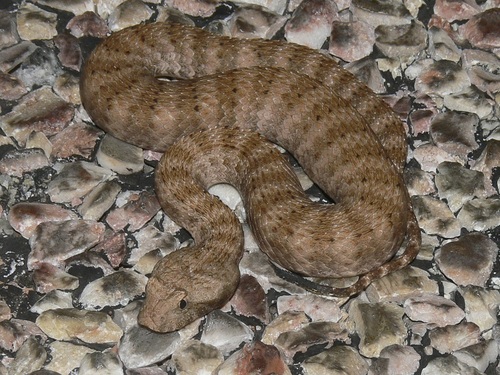
Pilbara Death Adder
Acanthophis wellsi

Mulga Snake
Pseudechis australis

Orange-naped Snake
Furina ornata
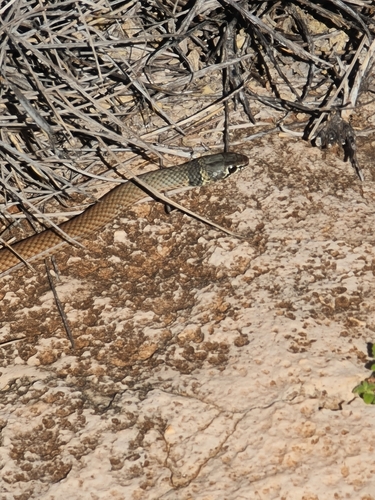
Black-necked Whipsnake
Demansia calodera

Olive Sea Snake
Aipysurus laevis

Desert Banded Snake
Simoselaps bertholdi
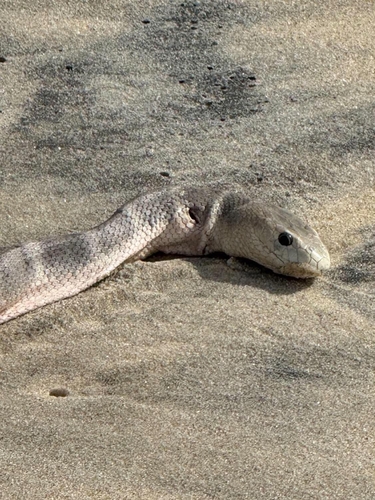
Spotted Sea Snake
Hydrophis ocellatus
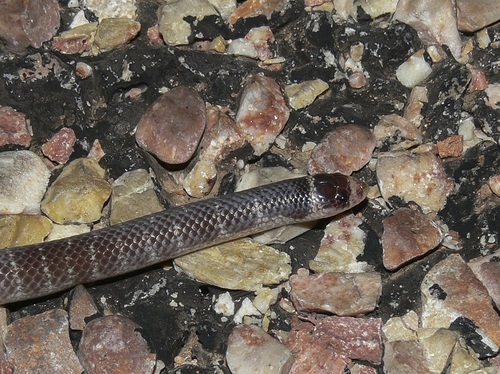
North-western Shovel-nosed Snake
Brachyurophis approximans
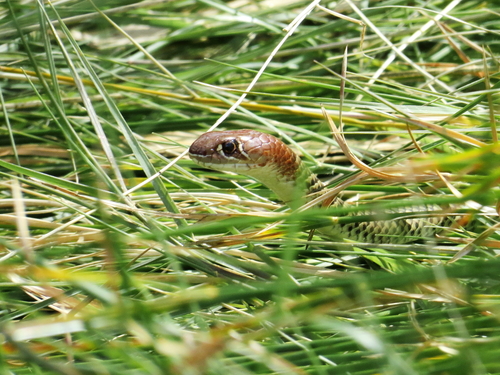
Reticulated Whipsnake
Demansia reticulata
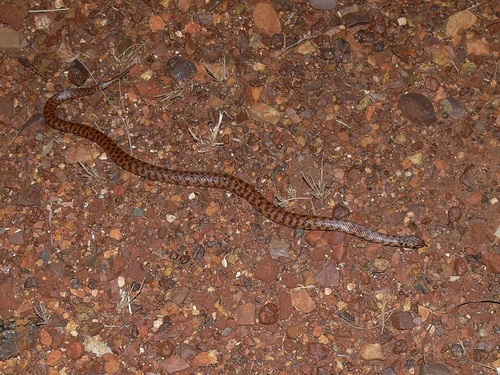
Rosen's Snake
Suta fasciata
Global Distribution
Where this species is recorded worldwide. Restricted to human observations from 2019 onwards — the same kind of record and the same period the probabilities on this page are built from, so collar-tracking studies, camera-trap arrays and museum specimens are excluded. Around Santa Rosa that removes 5,924 GPS fixes from a handful of tagged jaguars.
where this species is recorded (GBIF density — it tracks where observers go, not how likely a sighting is) · parks where it occurs — tap a pin for the sighting probability there
Parks Where Found
| # | Park | Country | Daily sighting probability |
|---|---|---|---|
| 1 | Uluru-Kata Tjuta National Park | 🇦🇺 Australia | |
| 2 | Cape Range | 🇦🇺 Australia | |
| 3 | Ningaloo Marine Park | 🇦🇺 Australia |