



Many-scaled Anole
Anolis polylepis
Silhouette: Sarah Werning · PhyloPic
- KingdomAnimalia (Animals)
- PhylumChordata (Chordates)
- ClassSquamata
- FamilyDactyloidae
- GenusAnolis (Anoles)
- SpeciesAnolis polylepis (Many-scaled Anole)
About the Many-scaled Anole
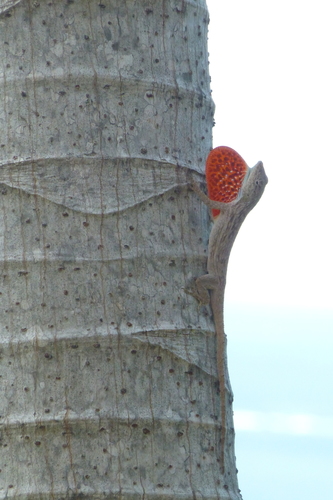
Anolis polylepis, the many-scaled anole or Golfo-Dulce anole, is a lizard endemic to the Gulf of Dulce area of Costa Rica. A brown and white speckled lizard with an orange-yellow dewlap, made of erectile cartilage, that extends from their throat. Their toes are covered with structures that allow them to cling to many different surfaces using the van der Waals force. Their tails have the ability to break off at special segments in order to escape predators or fights. The tail itself continues to wriggle strongly for some minutes after detaching. This ability is known as autotomy. The anoles are also diurnal, which means that they are active during the daytime.
They are athletic creatures that run fast, and jump many times their length. They can also climb straight up almost any surface at blinding speed. They usually sit downward. Seeing a potential prey they dart down towards it. They display their dewlap and bob their head to attract sexual partners and to mark their territory.
They feed on spiders and insects like cockroaches and mosquitoes. Wikipedia →
Recent sightings of Many-scaled Anole in Carara National Park
LIVEiNaturalist



Global Distribution
Warmer areas are where this animal is recorded most often.
Parks Where Found
| # | Park | Country | Daily sighting probability |
|---|---|---|---|
| 1 | Piedras Blancas National Park | 🇨🇷 Costa Rica | |
| 2 | Manuel Antonio National Park | 🇨🇷 Costa Rica | |
| 3 | Chirripó National Park | 🇨🇷 Costa Rica | |
| 4 | Carara National Park | 🇨🇷 Costa Rica | |
| 5 | Marino Ballena National Park | 🇨🇷 Costa Rica | |
| 6 | La Amistad International Park (Panama) | 🇵🇦 Panama | |
| 7 | Volcán Barú National Park | 🇵🇦 Panama | |
| 8 | Corcovado National Park | 🇨🇷 Costa Rica | |
| 9 | Tapantí-Macizo de la Muerte National Park | 🇨🇷 Costa Rica |
Quick answers
What are the chances of seeing a Many-scaled Anole in Carara National Park?
About 30% of wildlife watchers report a Many-scaled Anole sighting in Carara National Park, based on 39 verified sightings from GBIF citizen-science data.
When is the best time to see Many-scaled Anole in Carara National Park?
September has the highest sighting rate for Many-scaled Anole in Carara National Park in our monthly data.