



Blue-and-white Flycatcher
Cyanoptila cyanomelana
Silhouette: Martin Bulla, based on François Desbordes' illustration · PhyloPic
- KingdomAnimalia (Animals)
- PhylumChordata (Chordates)
- ClassAves (Birds)
- OrderPasseriformes (Perching Birds)
- FamilyMuscicapidae (Old World Flycatchers, Robins, and Chats)
- GenusCyanoptila (Blue-and-white and Zappey's Flycatchers)
- SpeciesCyanoptila cyanomelana (Blue-and-white Flycatcher)
About the Blue-and-white Flycatcher
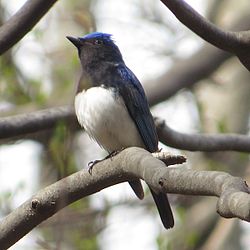
The blue-and-white flycatcher (Cyanoptila cyanomelana) is a migratory songbird in the Old World flycatcher family Muscicapidae. The species is also known as the Japanese flycatcher. It breeds in Japan, Korea, and in parts of north eastern China and the Russian Far East. It winters in South East Asia, especially in Vietnam, Cambodia, Thailand, Sumatra and Borneo. This species has been recorded as a vagrant from the Sinharaja Rainforest in Sri Lanka in 2014.
The species was first described in 1829 by Coenraad Jacob Temminck under the binomial name Muscicapa cyanomelana, and was transferred to its own genus Cyanoptila by Edward Blyth in 1847, on the basis of structural differences from other flycatchers, including its wing length and bill dimensions.
The genus name comes from ancient Greek; "kuanos" meaning dark blue, and "ptilon", plumage. The specific cyanomelana also comes from "kuanos", paired with melas, melanos meaning dark, black. Two subspecies are accepted: C. c. cyanomelana (Temminck, 1829) - breeds in Japan and the southern Kuril Islands; it migrates south to winter in Myanmar, Thailand, and the Greater Sundas.
C. c. intermedia... Wikipedia →
Recent sightings of Blue-and-white Flycatcher in Cat Tien National Park
LIVEiNaturalistClosest Relatives at Cat Tien National Park

 White-rumped Shama
Copsychus malabaricus

Oriental Magpie-Robin
Copsychus saularis

 Tickell's Blue Flycatcher
Cyornis tickelliae

 Asian Brown Flycatcher
Muscicapa latirostris

 Siberian Blue Robin
Luscinia cyane

Hainan Blue-Flycatcher
Cyornis hainanus

Verditer Flycatcher
Eumyias thalassinus

 Pied Bushchat
Saxicola caprata

Hill Blue Flycatcher
Cyornis whitei

 Taiga Flycatcher
Ficedula albicilla

White-Tailed Blue-Flycatcher
Cyornis concretus

Amur Stonechat
Saxicola stejnegeri
Global Distribution
Warmer areas are where this animal is recorded most often.
Parks Where Found
| # | Park | Country | Daily sighting probability |
|---|---|---|---|
| 1 | Nikko National Park | 🇯🇵 Japan | |
| 2 | Kinabalu Park | 🇲🇾 Malaysia | |
| 3 | Sepilok | 🇲🇾 Malaysia | |
| 4 | Khao Sok National Park | 🇹🇭 Thailand | |
| 5 | Khao Luang National Park | 🇹🇭 Thailand | |
| 6 | Khao Yai National Park | 🇹🇭 Thailand | |
| 7 | Cat Tien National Park | 🇻🇳 Vietnam | |
| 8 | Kaeng Krachan National Park | 🇹🇭 Thailand | |
| 9 | Kinabatangan Wildlife Sanctuary | 🇲🇾 Malaysia | |
| 10 | Danum Valley Conservation Area | 🇲🇾 Malaysia | |
| 11 | Bako National Park | 🇲🇾 Malaysia | |
| 12 | Kaziranga National Park | 🇮🇳 India | |
| 13 | Taman Negara National Park | 🇲🇾 Malaysia |
Quick answers
What are the chances of seeing a Blue-and-white Flycatcher in Cat Tien National Park?
Under 5% of wildlife watchers report a Blue-and-white Flycatcher sighting in Cat Tien National Park, based on 8 verified sightings from GBIF citizen-science data.
When is the best time to see Blue-and-white Flycatcher in Cat Tien National Park?
October has the highest sighting rate for Blue-and-white Flycatcher in Cat Tien National Park in our monthly data.