
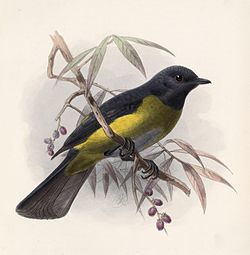



Black-and-yellow Phainoptila
Phainoptila melanoxantha
Silhouette: Sheatherius · PhyloPic
- KingdomAnimalia (Animals)
- PhylumChordata (Chordates)
- ClassAves (Birds)
- OrderPasseriformes (Perching Birds)
- FamilyPtilogonatidae
- GenusPhainoptila
- SpeciesPhainoptila melanoxantha (Black-and-yellow Phainoptila)
About the Black-and-yellow Phainoptila
The black-and-yellow phainoptila or black-and-yellow silky-flycatcher (Phainoptila melanoxantha) is a species of bird in the family Ptiliogonatidae, the silky-flycatchers. It is found in Costa Rica and Panama. The black-and-yellow phainoptila is the only member of its genus, but its further taxonomy is unresolved. The IOC, the Clements taxonomy, AviList, and the American Ornithological Society assign it two subspecies, the nominate P. m. melanoxantha (Salvin, 1877) and P. m. parkeri (Barrantes & Sánchez, JE, 2000). However, as of late 2025 BirdLife International's Handbook of the Birds of the World includes a third, P. m. minor. The IOC and AviList call the species black-and-yellow phainoptila and the others call it the black-and-yellow silky-flycatcher. The generic name Phainoptila is derived from the Greek and means "shining plumage".
The black-and-yellow phainoptila is about 20 cm (7.9 in) long. It weighs an average of 60 g (2.1 oz). It is a heavy-bodied bird with a wide rounded tail. Adult males of the nominate subspecies have a black head, back, wings, and tail. Their rump is bright yellow. Their throat is black, their breast olive... Wikipedia →
Recent sightings of Black-and-yellow Phainoptila in Chirripó National Park
LIVEiNaturalistClosest Relatives at Chirripó National Park

 Long-tailed Silky-flycatcher
Ptilogonys caudatus

Scarlet-rumped Tanager
Ramphocelus passerinii

Silver-throated Tanager
Tangara icterocephala

Golden-hooded Tanager
Stilpnia larvata

Blue-gray Tanager
Thraupis episcopus

 Clay-colored Thrush
Turdus grayi

Palm Tanager
Thraupis palmarum

Buff-throated Saltator
Saltator maximus

 Great Kiskadee
Pitangus sulphuratus

Speckled Tanager
Ixothraupis guttata

 Bananaquit
Coereba flaveola

 Southern House Wren
Troglodytes musculus
Global Distribution
Warmer areas are where this animal is recorded most often.
Parks Where Found
| # | Park | Country | Daily sighting probability |
|---|---|---|---|
| 1 | Poás Volcano National Park | 🇨🇷 Costa Rica | |
| 2 | Tapantí-Macizo de la Muerte National Park | 🇨🇷 Costa Rica | |
| 3 | Irazú Volcano National Park | 🇨🇷 Costa Rica | |
| 4 | Volcán Barú National Park | 🇵🇦 Panama | |
| 5 | Los Quetzales National Park | 🇨🇷 Costa Rica | |
| 6 | La Amistad International Park (Panama) | 🇵🇦 Panama | |
| 7 | Braulio Carrillo National Park | 🇨🇷 Costa Rica | |
| 8 | Monteverde Cloud Forest Reserve | 🇨🇷 Costa Rica | |
| 9 | Chirripó National Park | 🇨🇷 Costa Rica | |
| 10 | Tenorio Volcano National Park | 🇨🇷 Costa Rica | |
| 11 | Arenal Volcano National Park | 🇨🇷 Costa Rica |
Quick answers
What are the chances of seeing a Black-and-yellow Phainoptila in Chirripó National Park?
Under 5% of wildlife watchers report a Black-and-yellow Phainoptila sighting in Chirripó National Park, based on 12 verified sightings from GBIF citizen-science data.
When is the best time to see Black-and-yellow Phainoptila in Chirripó National Park?
March has the highest sighting rate for Black-and-yellow Phainoptila in Chirripó National Park in our monthly data.