
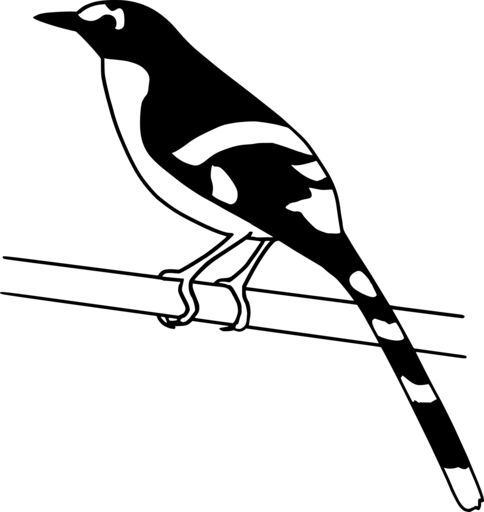
Black-backed Forktail
Enicurus immaculatus
Silhouette: Andy Wilson · PhyloPic
- KingdomAnimalia (Animals)
- PhylumChordata (Chordates)
- ClassAves (Birds)
- OrderPasseriformes (Perching Birds)
- FamilyMuscicapidae (Old World Flycatchers, Robins, and Chats)
- GenusEnicurus (Forktails)
- SpeciesEnicurus immaculatus (Black-backed Forktail)
About the Black-backed Forktail
The black-backed forktail (Enicurus immaculatus), occasionally referred to as the black-throated forktail, is a forktail species in the family Muscicapidae. The species was described in 1836, from a specimen collected in Nepal. It is a medium-sized forktail, weighing between 25 and 29 grams, with a length of 20.5 to 23 centimetres (8+1⁄8 to 9 in). The species has a broad white stripe across its forehead. The crown, face, and mantle are black, while the bird's underparts are white, sharply divided from the black above. The wings are largely black with a broad white stripe across the greater coverts. The tail of the species, similar to that of other forktails, is long, graduated, and deeply forked. The tail is black with a white tip and three white bands created by shorter tail feathers. The beak of the bird is black, while the feet and legs are light pink, and the iris is brown. The species is monomorphic.
The black backed forktail is solitary, but is occasionally found in pairs or in family groups. It is described as a shy species. The bird breeds between March and June, building a nest of plant matter in holes or crevices in rocks and dead trees. Three eggs are generally laid, which are pink and spotted with red-brown. Both sexes build the nest and incubate the eggs. The species frequents fast-flowing rivers and streams in temperate forests and subtropical or tropical moist lowland forests. It is found in the Indian subcontinent and in some adjoining regions of Southeast Asia. It ranges across Bangladesh, Bhutan, India, Myanmar, Nepal and Thailand. It is generally found below 1,450 metres (4,760 ft) above sea level, but has been recorded as high as 2,600 metres (8,530 ft). Its precise range and population are unknown. It is classified as a species of Least Concern by the International Union for Conservation of Nature. Wikipedia →
Recent sightings of Black-backed Forktail in Chitwan National Park
LIVEiNaturalistClosest Relatives at Chitwan National Park

 Spotted Forktail
Enicurus maculatus

Little Forktail
Enicurus scouleri

Slaty-backed Forktail
Enicurus schistaceus

 Oriental Magpie-Robin
Copsychus saularis

 Pied Bushchat
Saxicola caprata

Siberian Stonechat
Saxicola maurus

 Taiga Flycatcher
Ficedula albicilla

White-rumped Shama
Copsychus malabaricus

White-tailed Stonechat
Saxicola leucurus

 Pale-chinned Blue-Flycatcher
Cyornis poliogenys

Black Redstart
Phoenicurus ochruros

Verditer Flycatcher
Eumyias thalassinus
Global Distribution
Warmer areas are where this animal is recorded most often.
Parks Where Found
| # | Park | Country | Daily sighting probability |
|---|---|---|---|
| 1 | Namdapha National Park | 🇮🇳 India | |
| 2 | Doi Inthanon National Park | 🇹🇭 Thailand | |
| 3 | Royal Manas National Park | 🇧🇹 Bhutan | |
| 4 | Chitwan National Park | 🇳🇵 Nepal | |
| 5 | Kaziranga National Park | 🇮🇳 India | |
| 6 | Manas National Park | 🇮🇳 India | |
| 7 | Khangchendzonga National Park | 🇮🇳 India | |
| 8 | Royal Bardia National Park | 🇳🇵 Nepal | |
| 9 | Langtang National Park | 🇳🇵 Nepal |
Quick answers
What are the chances of seeing a Black-backed Forktail in Chitwan National Park?
About 10% of wildlife watchers report a Black-backed Forktail sighting in Chitwan National Park, based on 91 verified sightings from GBIF citizen-science data.
When is the best time to see Black-backed Forktail in Chitwan National Park?
January has the highest sighting rate for Black-backed Forktail in Chitwan National Park in our monthly data.