

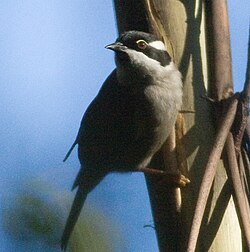



Strong-billed Honeyeater
Melithreptus validirostris
Silhouette: Rachael Joakim · PhyloPic
- KingdomAnimalia (Animals)
- PhylumChordata (Chordates)
- ClassAves (Birds)
- OrderPasseriformes (Perching Birds)
- FamilyMeliphagidae (Honeyeaters)
- GenusMelithreptus (Dark-headed Honeyeaters)
- SpeciesMelithreptus validirostris (Strong-billed Honeyeater)
About the Strong-billed Honeyeater
The strong-billed honeyeater (Melithreptus validirostris) is a species of bird in the family Meliphagidae. It is one of two species of the genus Melithreptus endemic to Tasmania. Its natural habitat is temperate forest. The strong-billed honeyeater was first described by ornithologist John Gould in 1837. Its specific name is derived from the Latin words validus 'strong', and rostrum 'bill'. It is a member of the genus Melithreptus, with several species of similar size and (apart from the brown-headed honeyeater) black-headed appearance, in the honeyeater family, Meliphagidae. Molecular markers show that the strong-billed honeyeater separated from the common ancestor of the brown-headed and black-chinned honeyeaters between 6.7 and 3.4 million years ago.
The next closest relative outside the genus is the much larger, but similarly marked, blue-faced honeyeater. More recently, DNA analysis has shown honeyeaters to be related to the Pardalotidae (pardalotes), Acanthizidae (Australian warblers, scrubwrens, thornbills, etc.), and the Maluridae (Australian fairy-wrens) in the large superfamily Meliphagoidea.
A mid-sized honeyeater at 16.5–17.5 cm (6.5–7 in... Wikipedia →
Recent sightings of Strong-billed Honeyeater in Cradle Mountain-Lake St Clair National Park
LIVEiNaturalistClosest Relatives at Cradle Mountain-Lake St Clair National Park

 Black-headed Honeyeater
Melithreptus affinis

Crescent Honeyeater
Phylidonyris pyrrhopterus

 Yellow Wattlebird
Anthochaera paradoxa

Yellow-throated Honeyeater
Nesoptilotis flavicollis

 Eastern Spinebill
Acanthorhynchus tenuirostris

New Holland Honeyeater
Phylidonyris novaehollandiae

Little Wattlebird
Anthochaera chrysoptera

Noisy Miner
Manorina melanocephala

 Black Currawong
Strepera fuliginosa

 Tasmanian Scrubwren
Sericornis humilis

 Tasmanian Thornbill
Acanthiza ewingii

 Welcome Swallow
Hirundo neoxena
Global Distribution
Warmer areas are where this animal is recorded most often.
Parks Where Found
| # | Park | Country | Daily sighting probability |
|---|---|---|---|
| 1 | Cradle Mountain-Lake St Clair National Park | 🇦🇺 Australia | |
| 2 | Maria Island National Park | 🇦🇺 Australia | |
| 3 | Freycinet National Park | 🇦🇺 Australia |
Quick answers
What are the chances of seeing a Strong-billed Honeyeater in Cradle Mountain-Lake St Clair National Park?
About 20% of wildlife watchers report a Strong-billed Honeyeater sighting in Cradle Mountain-Lake St Clair National Park, based on 99 verified sightings from GBIF citizen-science data.
When is the best time to see Strong-billed Honeyeater in Cradle Mountain-Lake St Clair National Park?
April has the highest sighting rate for Strong-billed Honeyeater in Cradle Mountain-Lake St Clair National Park in our monthly data.