Meliphagidae (Honeyeaters)

Family

Honeyeaters

Meliphagidae

82 species in our catalog · found in 26 parks

Species in this group

Each card shows the species at its best park — tap for the full profile

New Zealand Bellbird
LC Endemic

New Zealand Bellbird

☀️ Diurnal Bird

Anthornis melanura

90–100% · Very likely
Lewin's Honeyeater
LC Endemic

Lewin's Honeyeater

☀️ Diurnal Bird

Meliphaga lewinii

80–90% · Very likely
Tūī
LC Endemic

Tūī

☀️ Diurnal Bird

Prosthemadera novaeseelandiae

80–90% · Very likely
Crescent Honeyeater
LC Endemic

Crescent Honeyeater

☀️ Diurnal Bird

Phylidonyris pyrrhopterus

80–90% · Very likely
White-plumed Honeyeater
LC Endemic

White-plumed Honeyeater

☀️ Diurnal Bird

Ptilotula penicillata

80–90% · Very likely
Yellow-throated Miner
LC Endemic

Yellow-throated Miner

☀️ Diurnal Bird

Manorina flavigula

70–80% · Very likely
Singing Honeyeater
LC Endemic

Singing Honeyeater

☀️ Diurnal Bird

Gavicalis virescens

70–80% · Very likely
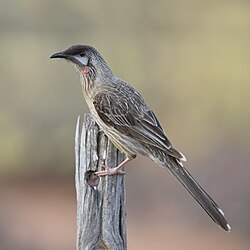
Red Wattlebird
LC Endemic

Red Wattlebird

☀️ Diurnal Bird

Anthochaera carunculata

70–80% · Very likely
Smoky Honeyeater
LC

Smoky Honeyeater

🌅 Crepuscular Bird

Melipotes fumigatus

70–80% · Very likely
Yellow Wattlebird
LC Endemic

Yellow Wattlebird

🌙 Nocturnal Bird

Anthochaera paradoxa

70–80% · Very likely
Noisy Friarbird
LC

Noisy Friarbird

☀️ Diurnal Bird

Philemon corniculatus

60–70% · Likely
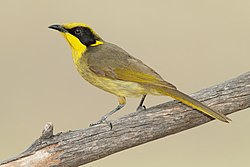
Yellow-faced Honeyeater
LC Endemic

Yellow-faced Honeyeater

☀️ Diurnal Bird

Caligavis chrysops

60–70% · Likely
Belford's Melidectes
LC

Belford's Melidectes

🌅 Crepuscular Bird

Melidectes belfordi

60–70% · Likely
Red-collared Myzomela
LC

Red-collared Myzomela

🌅 Crepuscular Bird

Myzomela rosenbergii

60–70% · Likely
Yellow-throated Honeyeater
LC Endemic

Yellow-throated Honeyeater

🌅 Crepuscular Bird

Nesoptilotis flavicollis

60–70% · Likely
New Holland Honeyeater
LC Endemic

New Holland Honeyeater

☀️ Diurnal Bird

Phylidonyris novaehollandiae

60–70% · Likely
Spiny-cheeked Honeyeater
LC Endemic

Spiny-cheeked Honeyeater

☀️ Diurnal Bird

Acanthagenys rufogularis

60–70% · Likely
Eastern Spinebill
LC Endemic

Eastern Spinebill

☀️ Diurnal Bird

Acanthorhynchus tenuirostris

60–70% · Likely
Black-backed Honeyeater
LC

Black-backed Honeyeater

🌙 Nocturnal Bird

Ptiloprora perstriata

60–70% · Likely
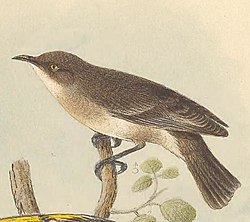
Brown Honeyeater
LC

Brown Honeyeater

☀️ Diurnal Bird

Lichmera indistincta

60–70% · Likely
Noisy Miner
LC Endemic

Noisy Miner

☀️ Diurnal Bird

Manorina melanocephala

60–70% · Likely
White-gaped Honeyeater
LC Endemic

White-gaped Honeyeater

☀️ Diurnal Bird

Stomiopera unicolor

50–60% · Likely
Little Wattlebird
LC Endemic

Little Wattlebird

☀️ Diurnal Bird

Anthochaera chrysoptera

50–60% · Likely
White-throated Honeyeater
LC

White-throated Honeyeater

☀️ Diurnal Bird

Melithreptus albogularis

50–60% · Likely
Helmeted Friarbird
LC

Helmeted Friarbird

☀️ Diurnal Bird

Philemon buceroides

50–60% · Likely
Blue-faced Honeyeater
LC

Blue-faced Honeyeater

☀️ Diurnal Bird

Entomyzon cyanotis

50–60% · Likely
Silver-crowned Friarbird
LC Endemic

Silver-crowned Friarbird

☀️ Diurnal Bird

Philemon argenticeps

50–60% · Likely
Yellow-spotted Honeyeater
LC Endemic

Yellow-spotted Honeyeater

🌅 Crepuscular Bird

Meliphaga notata

40–50% · Likely
Ornate Melidectes
LC

Ornate Melidectes

🌅 Crepuscular Bird

Melidectes torquatus

40–50% · Likely
Dusky Honeyeater
LC

Dusky Honeyeater

☀️ Diurnal Bird

Myzomela obscura

40–50% · Likely
Grey-headed Honeyeater
LC Endemic

Grey-headed Honeyeater

🌅 Crepuscular Bird

Ptilotula keartlandi

30–40% · Possible
Rufous-banded Honeyeater
LC

Rufous-banded Honeyeater

☀️ Diurnal Bird

Conopophila albogularis

30–40% · Possible
White-eared Honeyeater
LC Endemic

White-eared Honeyeater

☀️ Diurnal Bird

Nesoptilotis leucotis

30–40% · Possible
Little Friarbird
LC

Little Friarbird

☀️ Diurnal Bird

Philemon citreogularis

30–40% · Possible
Scarlet Myzomela
LC Endemic

Scarlet Myzomela

☀️ Diurnal Bird

Myzomela sanguinolenta

30–40% · Possible
Hornbill Friarbird

Hornbill Friarbird

Bird

Philemon yorki

20–30% · Possible
White-naped Honeyeater
LC Endemic

White-naped Honeyeater

☀️ Diurnal Bird

Melithreptus lunatus

20–30% · Possible
White-cheeked Honeyeater
LC Endemic

White-cheeked Honeyeater

☀️ Diurnal Bird

Phylidonyris niger

20–30% · Possible
White-lined Honeyeater

White-lined Honeyeater

☀️ Diurnal Bird

Territornis albilineata

20–30% · Possible
Crimson Chat
LC Endemic

Crimson Chat

🌅 Crepuscular Bird

Epthianura tricolor

20–30% · Possible
Grey-fronted Honeyeater
LC Endemic

Grey-fronted Honeyeater

🌅 Crepuscular Bird

Ptilotula plumula

20–30% · Possible
Macleay's Honeyeater
LC Endemic

Macleay's Honeyeater

🌅 Crepuscular Bird

Xanthotis macleayanus

10–20% · Possible
Black-throated Honeyeater
LC

Black-throated Honeyeater

🌅 Crepuscular Bird

Caligavis subfrenata

10–20% · Possible
Strong-billed Honeyeater
VU Endemic

Strong-billed Honeyeater

🌙 Nocturnal Bird

Melithreptus validirostris

10–20% · Possible
Brown-backed Honeyeater
LC

Brown-backed Honeyeater

🌙 Nocturnal Bird

Ramsayornis modestus

10–20% · Possible
Bar-breasted Honeyeater
LC Endemic

Bar-breasted Honeyeater

☀️ Diurnal Bird

Ramsayornis fasciatus

10–20% · Possible
Black-headed Honeyeater
LC Endemic

Black-headed Honeyeater

🌙 Nocturnal Bird

Melithreptus affinis

10–20% · Possible
Pied Honeyeater
LC Endemic

Pied Honeyeater

🌅 Crepuscular Bird

Certhionyx variegatus

10–20% · Possible
Brown-headed Honeyeater
LC Endemic

Brown-headed Honeyeater

☀️ Diurnal Bird

Melithreptus brevirostris

10–20% · Possible
Bell Miner
LC Endemic

Bell Miner

☀️ Diurnal Bird

Manorina melanophrys

10–20% · Possible
Hill-forest Honeyeater
LC

Hill-forest Honeyeater

Bird

Microptilotis orientalis

10–20% · Possible
Bridled Honeyeater
LC Endemic

Bridled Honeyeater

Bird

Bolemoreus frenatus

10–20% · With luck
Yellow-plumed Honeyeater
LC Endemic

Yellow-plumed Honeyeater

☀️ Diurnal Bird

Ptilotula ornata

10–20% · With luck
Streak-headed Honeyeater
LC

Streak-headed Honeyeater

Bird

Pycnopygius stictocephalus

Insufficient data
Yellow-tufted Honeyeater
LC Endemic

Yellow-tufted Honeyeater

☀️ Diurnal Bird

Lichenostomus melanops

10–20% · With luck
Rufous-throated Honeyeater
LC Endemic

Rufous-throated Honeyeater

☀️ Diurnal Bird

Conopophila rufogularis

10–20% · With luck
Banded Honeyeater
LC Endemic

Banded Honeyeater

☀️ Diurnal Bird

Cissomela pectoralis

10–20% · With luck
Green-backed Honeyeater
LC

Green-backed Honeyeater

Bird

Glycichaera fallax

10–20% · With luck
White-fronted Honeyeater
LC Endemic

White-fronted Honeyeater

☀️ Diurnal Bird

Purnella albifrons

0–10% · With luck
Red Myzomela
LC

Red Myzomela

Bird

Myzomela cruentata

0–10% · With luck

Showing the 60 most likely of 82 species — the park table below covers them all.

📅 Monthly Probability

Probability-weighted average across the group's species

40–50
Jan
40–50
Feb
40–50
Mar
40–50
Apr
40–50
May
40–50
Jun
40–50
Jul
40–50
Aug
40–50
Sep
40–50
Oct
40–50
Nov
40–50
Dec

🕐 When They're Spotted

When the group's species are recorded (aggregated)

☀️🌙🌙12am6am12pm6pm12am

Where to see Honeyeaters

Worldwide records of this group (human observations from 2019 onwards, GBIF). Pins mark our parks — tap one for the chance of seeing at least one species of the group there.

Parks Ranked

Chance of seeing at least one species of the group · number of its species present
#ParkCountrySpeciesP(≥1)
1 Grampians National Park 🇦🇺 Australia 23
90–100%
2 Blue Mountains National Park 🇦🇺 Australia 23
90–100%
3 Lorentz National Park 🇮🇩 Indonesia 23
90–100%
4 Nitmiluk National Park 🇦🇺 Australia 19
90–100%
5 Booderee National Park 🇦🇺 Australia 19
90–100%
6 Great Otway National Park 🇦🇺 Australia 17
90–100%
7 Noosa National Park 🇦🇺 Australia 14
90–100%
8 Uluru-Kata Tjuta National Park 🇦🇺 Australia 12
90–100%
9 Cradle Mountain-Lake St Clair National Park 🇦🇺 Australia 9
90–100%
10 Freycinet National Park 🇦🇺 Australia 10
90–100%
11 Kakadu National Park 🇦🇺 Australia 15
90–100%
12 Flinders Ranges National Park 🇦🇺 Australia 15
90–100%
13 Springbrook National Park 🇦🇺 Australia 14
90–100%
14 Litchfield National Park 🇦🇺 Australia 14
90–100%
15 Rakiura National Park 🇳🇿 New Zealand 2
90–100%
16 Lamington National Park 🇦🇺 Australia 18
90–100%
17 Wilsons Promontory National Park 🇦🇺 Australia 15
90–100%
18 Kosciuszko National Park 🇦🇺 Australia 16
90–100%
19 Daintree National Park 🇦🇺 Australia 25
90–100%
20 Royal National Park 🇦🇺 Australia 21
90–100%
21 Arthur's Pass National Park 🇳🇿 New Zealand 2
90–100%
22 Tongariro National Park 🇳🇿 New Zealand 2
80–90%
23 Abel Tasman National Park 🇳🇿 New Zealand 2
80–90%
24 Fiordland National Park 🇳🇿 New Zealand 2
80–90%
25 Aoraki Mount Cook National Park 🇳🇿 New Zealand 2
60–70%
26 Bali Barat National Park 🇮🇩 Indonesia 1
20–30%