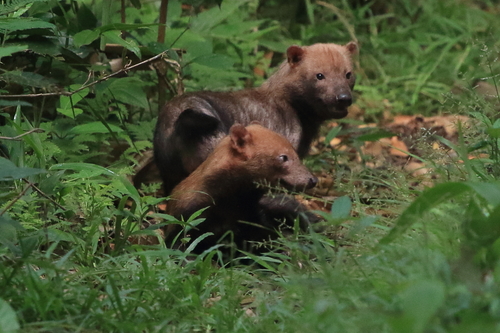

Bush Dog
Speothos venaticus
Silhouette: Margot Michaud · PhyloPic
- KingdomAnimalia (Animals)
- PhylumChordata (Chordates)
- ClassMammalia (Mammals)
- OrderCarnivora (Carnivorans)
- FamilyCanidae (Canids)
- GenusSpeothos (Bush Dogs)
- SpeciesSpeothos venaticus (Bush Dog)
About the Bush Dog
The bush dog (Speothos venaticus) is a canine found in Central and South America. In spite of its extensive range, it is very rare in most areas except in Suriname, Guyana and Peru; it was first described by Peter Wilhelm Lund from fossils in Brazilian caves and was believed to be extinct.
The bush dog is the only extant species in the genus Speothos, and genetic evidence suggests that its closest living relative is the maned wolf of central South America or the African wild dog. The species is listed as Near Threatened by the IUCN.
In Brazil, it is called cachorro-vinagre ('vinegar dog') and cachorro-do-mato ('bush dog'). In Spanish-speaking countries, it is called perro vinagre ('vinegar dog'), zorro vinagre ('vinegar fox'), perro de agua ('water dog'), and perro de monte ('shrub or woodland dog').
Adult bush dogs have soft long brownish-tan fur, with a lighter reddish tinge on the head, neck and back and a bushy tail, while the underside is dark, sometimes with a lighter throat patch. Younger individuals, however, have black fur over their entire bodies. Adults typically have a head-body length of 57–75 cm (22–30 in), with a 12.5–15 cm (5–6 in) tail. They have a... Wikipedia →
Recent sightings of Bush Dog in Cuyabeno Wildlife Reserve
LIVEiNaturalistClosest Relatives at Cuyabeno Wildlife Reserve

 Short-eared Dog
Atelocynus microtis

 Giant Otter
Pteronura brasiliensis

 Jaguar
Panthera onca

 Kinkajou
Potos flavus

 Tayra
Eira barbara

 Neotropical Otter
Lontra longicaudis

 South American Coati
Nasua nasua

 Mountain Lion
Puma concolor

 Ocelot
Leopardus pardalis

 Crab-eating Raccoon
Procyon cancrivorus

Margay
Leopardus wiedii
Global Distribution
Warmer areas are where this animal is recorded most often.
Parks Where Found
| # | Park | Country | Daily sighting probability |
|---|---|---|---|
| 1 | Sierra de la Macarena National Park | 🇨🇴 Colombia | |
| 2 | Madidi National Park | 🇧🇴 Bolivia | |
| 3 | Yasuní National Park | 🇪🇨 Ecuador | |
| 4 | Cuyabeno Wildlife Reserve | 🇪🇨 Ecuador | |
| 5 | Manu National Park | 🇵🇪 Peru |