



Chequered Keelback
Fowlea piscator
Silhouette: Alex Slavenko · PhyloPic
- KingdomAnimalia (Animals)
- PhylumChordata (Chordates)
- ClassSquamata
- FamilyColubridae (Colubrid Snakes)
- GenusFowlea (Fishing Keelbacks)
- SpeciesFowlea piscator (Chequered Keelback)
About the Chequered Keelback
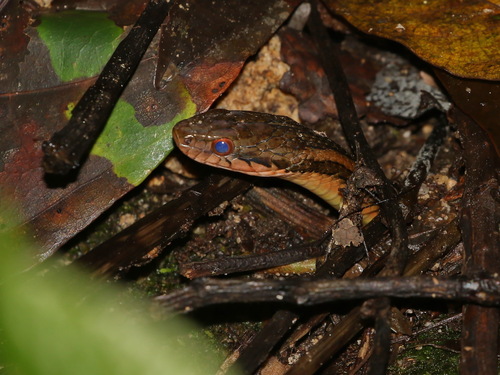
The checkered keelback (Fowlea piscator), also known commonly as the Asiatic water snake, is a common species in the subfamily Natricinae of the family Colubridae. The species is endemic to Asia. It is non-venomous. The eye of F. piscator is rather small and shorter than its distance from the nostril in the adult. Its rostral scale is visible from above. The internasal scales are much narrowed anteriorly and subtriangular, with the anterior angle truncated and as long as the prefrontal scales. The frontal scale is longer than its distance from the end of the snout, and as long as the parietals or a little shorter. The loreal is nearly as long as it is deep. There are one preocular and three (rarely four) post-oculars. Its temporals are 2+2 or 2+3. There are normally nine upper labials, with the fourth and fifth entering the eye; and five lower labials in contact with the anterior chin-shields, which are shorter than the posterior. The dorsal scales are arranged in 19 rows, strongly keeled, with outer rows smooth. The ventrals number 125–158, the anal is divided, and the subcaudals number 64–90. Coloration is very variable, consisting of dark spots arranged quincuncially... Wikipedia →
Recent sightings of Chequered Keelback in Doi Inthanon National Park
LIVEiNaturalistClosest Relatives at Doi Inthanon National Park

 Oriental Whipsnake
Ahaetulla prasina

 Banded Keelback
Rhabdophis nigrocinctus

Blue-eyed Bush Rat Snake
Gonyosoma coeruleum

Banded Wolf Snake
Lycodon fasciatus

Big-eyed Bamboo Snake
Pseudoxenodon macrops

Green Cat Snake
Boiga cyanea

Khasi Hills Keelback
Hebius khasiensis
Kutkai Keelback
Hebius bitaeniatus

Chinese Ratsnake
Ptyas korros

Collared Black-headed Snake
Sibynophis collaris

Black-banded Trinket Snake
Oreocryptophis porphyraceus

Deschauensee’s Keelback
Hebius deschauenseei
Global Distribution
Warmer areas are where this animal is recorded most often.
Parks Where Found
| # | Park | Country | Daily sighting probability |
|---|---|---|---|
| 1 | Keoladeo National Park | 🇮🇳 India | |
| 2 | Ranthambore National Park | 🇮🇳 India | |
| 3 | Chitwan National Park | 🇳🇵 Nepal | |
| 4 | Doi Inthanon National Park | 🇹🇭 Thailand | |
| 5 | Kaeng Krachan National Park | 🇹🇭 Thailand | |
| 6 | Khao Yai National Park | 🇹🇭 Thailand | |
| 7 | Sundarbans National Park | 🇮🇳 India | |
| 8 | Kanha National Park | 🇮🇳 India | |
| 9 | Satpura National Park | 🇮🇳 India | |
| 10 | Bandipur National Park | 🇮🇳 India | |
| 11 | Periyar National Park | 🇮🇳 India | |
| 12 | Mudumalai National Park | 🇮🇳 India | |
| 13 | Royal Bardia National Park | 🇳🇵 Nepal | |
| 14 | Jim Corbett National Park | 🇮🇳 India | |
| 15 | Nagarhole National Park | 🇮🇳 India |
Quick answers
What are the chances of seeing a Chequered Keelback in Doi Inthanon National Park?
About 10% of wildlife watchers report a Chequered Keelback sighting in Doi Inthanon National Park, based on 8 verified sightings from GBIF citizen-science data.
When is the best time to see Chequered Keelback in Doi Inthanon National Park?
November has the highest sighting rate for Chequered Keelback in Doi Inthanon National Park in our monthly data.