
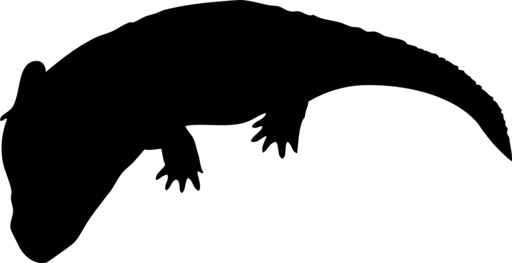
Savage's Cochran Frog
Centrolene savagei
Silhouette: Dmitry Bogdanov (vectorized by T. Michael Keesey) · PhyloPic
- KingdomAnimalia (Animals)
- PhylumChordata (Chordates)
- ClassAmphibia (Amphibians)
- OrderAnura (Frogs and Toads)
- FamilyCentrolenidae (Glass Frogs)
- GenusCentrolene
- SpeciesCentrolene savagei (Savage's Cochran Frog)
About the Savage's Cochran Frog
Centrolene savagei is a species of frog in the family Centrolenidae that is endemic to the Andes of western Colombia, specifically the Cordillera Occidental and Cordillera Central. Its common name is Savage's Cochran frog.
Centrolene savagei is a small glassfrog: adult females measure about 24 mm (0.9 in) in snout–vent length and adult males 20–24 mm (0.8–0.9 in) in snout–vent length, It has a wide head with a rounded snout and bulging eyes, and a slender body. The fingers and toes are tipped with adhesive pads. The body and legs are liberally covered with rounded whitish warts. The dorsal surface is bright green speckled with white or pale green, which makes it well-camouflaged on leaves, and the underparts are white and semi-transparent; the bones are green. The species has a number of defenses such as foul-smelling skin secretions and a variety of defensive postures and behaviors.
Adult male Centrolene savagei call at night after there has been rain during the day. The male advertisement call consists of 1–3 "peep" notes, each about 17 milliseconds in length (range 10–22 ms), and separated by silent intervals 302–442 ms in duration. Larger males... Wikipedia →
Recent sightings of Savage's Cochran Frog in Farallones de Cali National Natural Park
LIVEiNaturalistClosest Relatives at Farallones de Cali National Natural Park
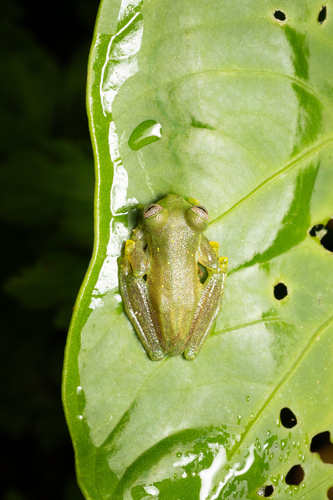
 Pijaos' Glassfrog
Nymphargus pijao
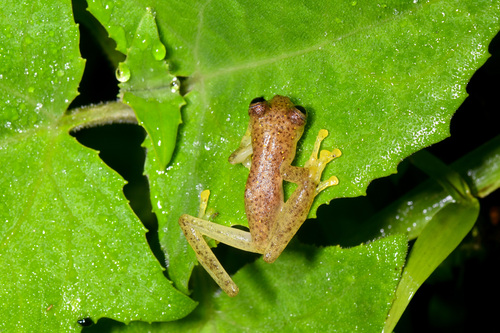
Lynch's Cochran Frog
Nymphargus ignotus

 Atrato Glass Frog
Hyalinobatrachium aureoguttatum

Orejuela's Glassfrog
Sachatamia orejuela

Ghost Glass Frog
Sachatamia ilex

Boettger's Colombian Tree Frog
Dendropsophus columbianus

 Giant Marine Toad
Rhinella horribilis

 Johnstone's Whistling Frog
Eleutherodactylus johnstonei

Palmer's Robber Frog
Pristimantis palmeri
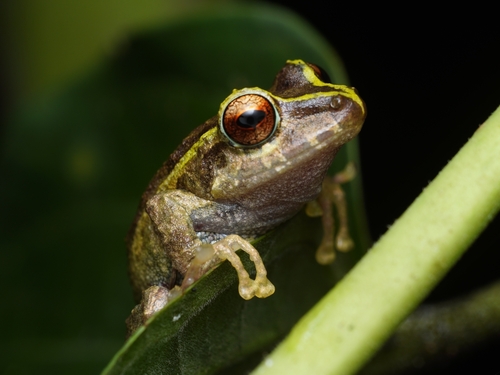
Colombian Robber Frog
Pristimantis erythropleura

Cachabi Robber Frog
Pristimantis achatinus

 Lehmann's Frog
Oophaga lehmanni
Global Distribution
Warmer areas are where this animal is recorded most often.
Parks Where Found
| # | Park | Country | Daily sighting probability |
|---|---|---|---|
| 1 | Los Nevados National Natural Park | 🇨🇴 Colombia | |
| 2 | Farallones de Cali National Natural Park | 🇨🇴 Colombia |