


Galápagos Giant Tortoise
Chelonoidis niger
Silhouette: Andrew A. Farke · PhyloPic
- KingdomAnimalia (Animals)
- PhylumChordata (Chordates)
- ClassTestudines
- FamilyTestudinidae (Tortoises)
- GenusChelonoidis (Galápagos Giant Tortoises and Allies)
- SpeciesChelonoidis niger (Galápagos Giant Tortoise)
About the Galápagos Giant Tortoise
The Galápagos tortoise (Chelonoidis niger), also called the Galápagos giant tortoise, is a very large species of tortoise in the genus Chelonoidis (which also contains three smaller species from mainland South America). The species comprises 15 subspecies (12 extant and 3 extinct). It is the largest living species of tortoise, and can weigh up to 417 kg (919 lb). They are also the largest extant terrestrial cold-blooded animals (ectotherms).
With lifespans in the wild of over 100 years, it is one of the longest-lived vertebrates. Captive Galapagos tortoises can live up to 177 years. For example, a captive individual, Harriet, lived for at least 175 years. Spanish explorers, who discovered the islands in the 16th century, named them after the Spanish galápago, meaning "tortoise".
Galápagos tortoises are native to seven of the Galápagos Islands. Shell size and shape vary between subspecies and populations. On islands with humid highlands and abundant low vegetation, the tortoises are larger, with domed shells and short necks; on islands with dry lowlands and less ground-level vegetation, the tortoises are smaller, with "saddleback" shells and long necks. Charles Darwin's observations of these differences on the second voyage of the Beagle in 1835 contributed to the development of his theory of evolution.
Tortoise numbers declined from over 250,000 in the 16th century to a low of around 15,000 in the 1970s. This decline was caused by overexploitation of the subspecies for meat and oil, habitat clearance for agriculture, and introduction of non-native animals to the islands, such as rats, goats, and pigs. The extinction of most giant tortoise lineages is thought to have also been caused by predation by humans or human ancestors, as the tortoises themselves have no natural predators. Tortoise populations on at least three islands have become extinct in historical times due to human activities. Specimens of these extinct taxa exist in several museums and also are being subjected to DNA analysis. 12 subspecies of the original 14–15 survive in the wild; a 13th subspecies (C. n. abingdonii) had only a single known living individual, kept in captivity and nicknamed Lonesome George until his death in June 2012. Two other subspecies, C. n. niger (the type subspecies of Galápagos tortoise) from Floreana Island and an undescribed subspecies from Santa Fe Island are known to have gone extinct in the mid-late 19th century. Wikipedia →
Recent sightings of Galápagos Giant Tortoise in Galápagos Islands
LIVEiNaturalistClosest Relatives at Galápagos Islands

 Indefatigable Island Giant Tortoise
Chelonoidis porteri

Sierra Negra Giant Tortoise
Chelonoidis guntheri

Chatham Island Giant Tortoise
Chelonoidis chathamensis

Alcedo Volcano Giant Tortoise
Chelonoidis vandenburghi

Isabela Island Giant Tortoise
Chelonoidis vicina

Hood Island Giant Tortoise
Chelonoidis hoodensis

Volcan Wolf Giant Tortoise
Chelonoidis becki
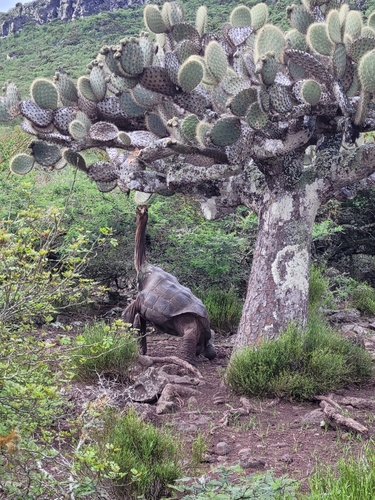
Duncan Island Giant Tortoise
Chelonoidis duncanensis
Global Distribution
Warmer areas are where this animal is recorded most often.
Parks Where Found
| # | Park | Country | Daily sighting probability |
|---|---|---|---|
| 1 | Galápagos Islands | 🇪🇨 Ecuador |
More parks will be added in future updates.
Quick answers
What are the chances of seeing a Galápagos Giant Tortoise in Galápagos Islands?
About 50% of wildlife watchers report a Galápagos Giant Tortoise sighting in Galápagos Islands, based on 1,312 verified sightings from GBIF citizen-science data.
When is the best time to see Galápagos Giant Tortoise in Galápagos Islands?
May has the highest sighting rate for Galápagos Giant Tortoise in Galápagos Islands in our monthly data.