
Hood Island Giant Tortoise
Chelonoidis hoodensis
Silhouette: Andrew A. Farke · PhyloPic
- KingdomAnimalia (Animals)
- PhylumChordata (Chordates)
- ClassTestudines
- FamilyTestudinidae (Tortoises)
- GenusChelonoidis (Galápagos Giant Tortoises and Allies)
- SpeciesChelonoidis hoodensis (Hood Island Giant Tortoise)
About the Hood Island Giant Tortoise
The Hood Island giant tortoise (Chelonoidis hoodensis), also known commonly as the Española giant tortoise, is a subspecies of Galápagos tortoise native to Española Island in the Galápagos. The first description of the subspecies was published in 1907 by John Van Denburgh, who used the name Testudo hoodensis for it. Española Island used to be called Hood Island, and that was the name which Van Denburgh knew the island by when he gave the subspecies the name hoodensis. The holotype, a female, was caught by Joseph R. Slevin and E.S. King in June 1906 and brought back with them to San Francisco, where it was entered into the collection of the California Academy of Sciences and allowed to live in Golden Gate Park. The species has subsequently been moved between different genera and between being considered as a species in its own right or as a subspecies of Chelonoidis niger.
This population was very heavily exploited by whalers in the 19th century and collapsed around 1850. 13 adults were found in the early 1970s and held at the Charles Darwin Research Station as a breeding colony. The two males and 11 females were initially brought to the Darwin... Wikipedia →
Recent sightings of Hood Island Giant Tortoise in Galápagos Islands
LIVEiNaturalistClosest Relatives at Galápagos Islands

 Galápagos Giant Tortoise
Chelonoidis niger

Indefatigable Island Giant Tortoise
Chelonoidis porteri

Sierra Negra Giant Tortoise
Chelonoidis guntheri

Chatham Island Giant Tortoise
Chelonoidis chathamensis

Alcedo Volcano Giant Tortoise
Chelonoidis vandenburghi

Isabela Island Giant Tortoise
Chelonoidis vicina

Volcan Wolf Giant Tortoise
Chelonoidis becki
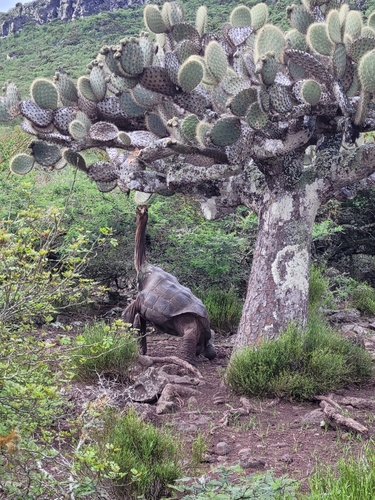
Duncan Island Giant Tortoise
Chelonoidis duncanensis
Global Distribution
Warmer areas are where this animal is recorded most often.
Parks Where Found
| # | Park | Country | Daily sighting probability |
|---|---|---|---|
| 1 | Galápagos Islands | 🇪🇨 Ecuador |
More parks will be added in future updates.