
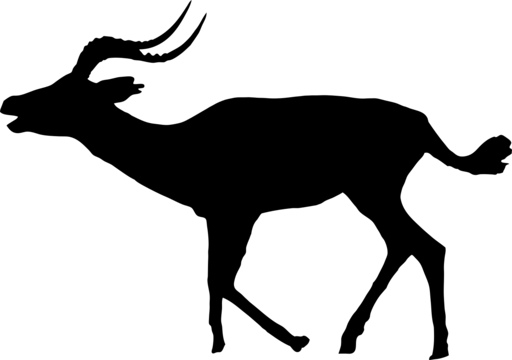
Blue Duiker
Philantomba monticola
Silhouette: [unknown] · PhyloPic
- KingdomAnimalia (Animals)
- PhylumChordata (Chordates)
- ClassMammalia (Mammals)
- OrderArtiodactyla (Even-toed Ungulates and Cetaceans)
- FamilyBovidae (Bovids)
- GenusPhilantomba (Blue Duikers)
- SpeciesPhilantomba monticola (Blue Duiker)
About the Blue Duiker
The blue duiker (Philantomba monticola) is a small antelope found in central, southern and eastern Africa. It is the smallest species of duiker. The species was first described by Swedish naturalist Carl Peter Thunberg in 1789. 12 subspecies are identified. The blue duiker reaches 32–41 centimetres (13–16 in) at the shoulder and weighs 3.5–9 kilograms (7.7–19.8 lb). Sexually dimorphic, the females are slightly larger than the males. The dark tail measures slightly above 10 centimetres (3.9 in). It has short, spiky horns, around 5 centimetres (2.0 in) long and hidden in hair tufts. The subspecies show a great degree of variation in their colouration. The blue duiker bears a significant resemblance to Maxwell's duiker.
Activity is diurnal (limited to daytime). Secretive and cautious, the blue duiker confines itself to the forest fringes. Territorial, individuals of opposite sexes form pairs and occupy territories, nearly 0.4–0.8 hectares (0.0015–0.0031 sq mi) large and marked by preorbital gland secretions. The blue duiker feeds on fallen fruits, foliage, flowers and pieces of bark, provided mainly by the forest canopies in their habitat. The age when sexual maturity is gained has been given differently by different studies. The species is monogamous, with pairs remaining together throughout the year. The length of the gestational period has been estimated from as little as four months to as long as seven months. Births occur throughout the year, though the birth rate might fall in the dry season. The calf is mainly kept in hiding and weaning occurs at 2.5 to 3 months.
The habitat consists of a variety of forests, including old-growth, secondary, and gallery forests. Forests are preferred as these provide the animal with shelter through the dense understory and forage through the canopy. Though categorized as Least Concern by the International Union for Conservation of Nature and Natural Resources (IUCN), the blue duiker is under threat from extensive bushmeat hunting across its range. Wikipedia →
Recent sightings of Blue Duiker in Garden Route National Park
LIVEiNaturalistClosest Relatives at Garden Route National Park

 Northern Bushbuck
Tragelaphus scriptus

 Cape Grysbok
Raphicerus melanotis

 Springbok
Antidorcas marsupialis

 Waterbuck
Kobus ellipsiprymnus

Klipspringer
Oreotragus oreotragus

Blue Wildebeest
Connochaetes taurinus

 Nyala
Tragelaphus angasii

 Common Eland
Taurotragus oryx

Bontebok/Blesbok
Damaliscus pygargus

 African Buffalo
Syncerus caffer

 Khama
Alcelaphus caama

 Bush Duiker
Sylvicapra grimmia
Global Distribution
Warmer areas are where this animal is recorded most often.
Parks Where Found
| # | Park | Country | Daily sighting probability |
|---|---|---|---|
| 1 | Garden Route National Park | 🇿🇦 South Africa | |
| 2 | Addo Elephant National Park | 🇿🇦 South Africa | |
| 3 | Kibale National Park | 🇺🇬 Uganda |
Quick answers
What are the chances of seeing a Blue Duiker in Garden Route National Park?
About 10% of wildlife watchers report a Blue Duiker sighting in Garden Route National Park, based on 26 verified sightings from GBIF citizen-science data.
When is the best time to see Blue Duiker in Garden Route National Park?
February has the highest sighting rate for Blue Duiker in Garden Route National Park in our monthly data.