


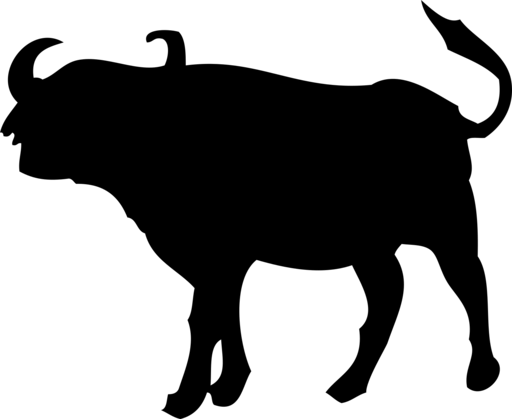
African Buffalo
Syncerus caffer
Silhouette: Jan A. Venter, Herbert H. T. Prins, David A. Balfour & Rob Slotow (vectorized by T. Michael Keesey) · PhyloPic
- KingdomAnimalia (Animals)
- PhylumChordata (Chordates)
- ClassMammalia (Mammals)
- OrderArtiodactyla (Even-toed Ungulates and Cetaceans)
- FamilyBovidae (Bovids)
- GenusSyncerus (African Buffaloes)
- SpeciesSyncerus caffer (African Buffalo)
About the African Buffalo
The African buffalo (Syncerus caffer) is a large species of true buffalo native to Sub-Saharan Africa, where it is found in a number of disconnected ranges stretching from south-eastern Senegal through West and Central Africa to South Africa. The adult African buffalo's horns are its characteristic feature: they have fused bases that form a continuous bone shield, referred to as a "boss", across the top of the head. The African buffalo is more closely related to Asian buffalo (Bubalus) species than it is to other bovids such as American bison or domestic cattle. Its unpredictable temperament may be part of the reason that the African buffalo has never been domesticated and has no domesticated descendants, unlike the wild yak and wild water buffalo, which are the ancestors of the domestic yak and water buffalo, respectively. Natural predators of adult African buffaloes include lions, African wild dogs, spotted hyenas, and Nile crocodiles. As one of the Big Five game animals, the Cape buffalo (Syncerus caffer caffer), the largest subspecies native to eastern and southern Africa, is a sought-after trophy in hunting.
The African buffalo is a very robust species. Its shoulder... Wikipedia →
Recent sightings of African Buffalo in Garden Route National Park
LIVEiNaturalistClosest Relatives at Garden Route National Park

 Northern Bushbuck
Tragelaphus scriptus

 Blue Duiker
Philantomba monticola

Cape Grysbok
Raphicerus melanotis

 Springbok
Antidorcas marsupialis

 Waterbuck
Kobus ellipsiprymnus

Klipspringer
Oreotragus oreotragus

Blue Wildebeest
Connochaetes taurinus

 Nyala
Tragelaphus angasii

 Common Eland
Taurotragus oryx

Bontebok/Blesbok
Damaliscus pygargus

 Khama
Alcelaphus caama

 Bush Duiker
Sylvicapra grimmia
Global Distribution
Warmer areas are where this animal is recorded most often.