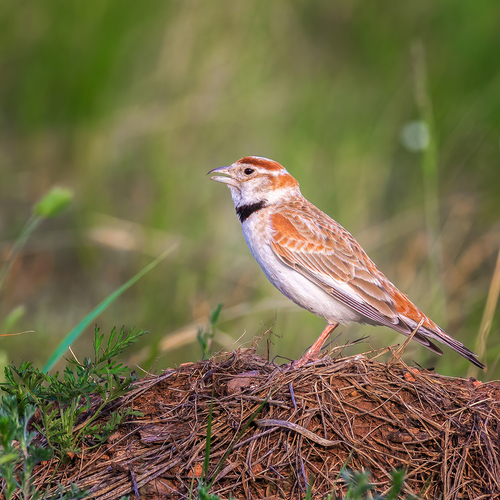
Mongolian Lark
Melanocorypha mongolica
Silhouette: Gossipguy and T. Michael Keesey · PhyloPic
- KingdomAnimalia (Animals)
- PhylumChordata (Chordates)
- ClassAves (Birds)
- OrderPasseriformes (Perching Birds)
- FamilyAlaudidae (Larks)
- GenusMelanocorypha (Black-necked Larks)
- SpeciesMelanocorypha mongolica (Mongolian Lark)
About the Mongolian Lark
The Mongolian lark (Melanocorypha mongolica) is a species of lark in the family Alaudidae found from southern Russia and Mongolia to central China. The Mongolian lark is known for its elaborate singing and even well into adulthood, is able to learn new songs. While female Mongolian larks don't sing, they have noteworthy song control nuclei with strong connectivity. Male Mongolian larks have large song bouts and song phrases that allow them to have extremely large song control nuclei.
It is an indicator species for avian biodiversity in the Mongolian steppes. It is most often seen alone. Its predators include the Saker Falcon. The black lark was originally placed in the genus Alauda. Alternate names for the black lark include Mongolian sand-lark and Mongolian skylark. Its head is pale brown, with a red crown. Its upper part is reddish-brown, and its lower part is yellowish-white.
On average, it lays clutches of 3.3 eggs and incubates them for 13 days. They remain nestlings for 10 days. About half of its eggs tend to survive. Wikipedia →
Recent sightings of Mongolian Lark in Gobi Gurvansaikhan National Park
LIVEiNaturalistClosest Relatives at Gobi Gurvansaikhan National Park

 Horned Lark
Eremophila alpestris

 Asian Short-toed Lark
Alaudala cheleensis

Crested Lark
Galerida cristata

Skylark
Alauda arvensis

Greater Short-toed Lark
Calandrella brachydactyla

Mediterranean Short-toed Lark
Calandrella rufescens

 Isabelline Wheatear
Oenanthe isabellina

 Isabelline Shrike
Lanius isabellinus

 Eurasian Tree Sparrow
Passer montanus

Desert Wheatear
Oenanthe deserti

 Common Raven
Corvus corax

 White-winged Snowfinch
Montifringilla nivalis
Global Distribution
Warmer areas are where this animal is recorded most often.
Parks Where Found
| # | Park | Country | Daily sighting probability |
|---|---|---|---|
| 1 | Gobi Gurvansaikhan National Park | 🇲🇳 Mongolia |
More parks will be added in future updates.
Quick answers
What are the chances of seeing a Mongolian Lark in Gobi Gurvansaikhan National Park?
Under 5% of wildlife watchers report a Mongolian Lark sighting in Gobi Gurvansaikhan National Park, based on 21 verified sightings from GBIF citizen-science data.
When is the best time to see Mongolian Lark in Gobi Gurvansaikhan National Park?
January has the highest sighting rate for Mongolian Lark in Gobi Gurvansaikhan National Park in our monthly data.