



Horned Lark
Eremophila alpestris
Silhouette: Andy Wilson · PhyloPic
- KingdomAnimalia (Animals)
- PhylumChordata (Chordates)
- ClassAves (Birds)
- OrderPasseriformes (Perching Birds)
- FamilyAlaudidae (Larks)
- GenusEremophila (Horned Larks)
- SpeciesEremophila alpestris (Horned Lark)
About the Horned Lark
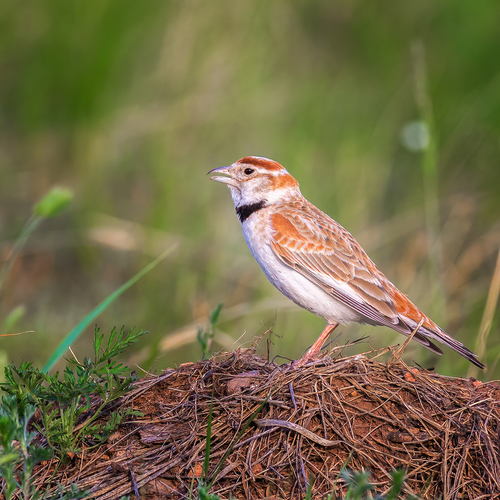
The horned lark or shore lark (Eremophila alpestris) is a species of lark in the family Alaudidae found across the northern hemisphere. It is known as "horned lark" in North America for distinctive feathers on the heads of the male birds in summer, and as "shore lark" in Europe because it can be found on shorelines in the winter.
The horned lark was formally described in 1758 by the Swedish naturalist Carl Linnaeus in the tenth edition of his Systema Naturae under the binomial name Alauda alpestris. Linnaeus based his account on the description and illustration by the English naturalist Mark Catesby in his book The Natural History of Carolina, Florida and the Bahama Islands that was published between 1729 and 1732. Linnaeus specified the type locality as North America but this has been restricted to the coastal areas of South Carolina. The horned lark is now placed together with Temminck's lark in the genus Eremophila that was introduced in 1828 by the German naturalist Friedrich Boie. The specific epithet alpestris is Latin meaning "of the high mountains", from Alpes, the Alps. A molecular genetic study of the Alaudidae published in 2023 found that Temminck's lark (Eremophila... Wikipedia →
Recent sightings of Horned Lark in Gobi Gurvansaikhan National Park
LIVEiNaturalistClosest Relatives at Gobi Gurvansaikhan National Park

 Asian Short-toed Lark
Alaudala cheleensis

Crested Lark
Galerida cristata

Skylark
Alauda arvensis
Mongolian Lark
Melanocorypha mongolica

Greater Short-toed Lark
Calandrella brachydactyla

Mediterranean Short-toed Lark
Calandrella rufescens

 Isabelline Wheatear
Oenanthe isabellina

 Isabelline Shrike
Lanius isabellinus

 Eurasian Tree Sparrow
Passer montanus

Desert Wheatear
Oenanthe deserti

 Common Raven
Corvus corax

 White-winged Snowfinch
Montifringilla nivalis
Global Distribution
Warmer areas are where this animal is recorded most often.
Parks Where Found
| # | Park | Country | Daily sighting probability |
|---|---|---|---|
| 1 | Gobi Gurvansaikhan National Park | 🇲🇳 Mongolia | |
| 2 | El Vizcaíno Biosphere Reserve | 🇲🇽 Mexico | |
| 3 | Wadden Sea National Park | 🇩🇪 Germany | |
| 4 | Gros Morne National Park | 🇨🇦 Canada | |
| 5 | Point Pelee National Park | 🇨🇦 Canada | |
| 6 | Wrangell-St. Elias National Park | 🇺🇸 United States | |
| 7 | Joshua Tree National Park | 🇺🇸 United States | |
| 8 | Yosemite National Park | 🇺🇸 United States | |
| 9 | Shenandoah National Park | 🇺🇸 United States | |
| 10 | Saguaro National Park | 🇺🇸 United States | |
| 11 | Denali National Park | 🇺🇸 United States | |
| 12 | Acadia National Park | 🇺🇸 United States | |
| 13 | Congaree National Park | 🇺🇸 United States | |
| 14 | Wood Buffalo National Park | 🇨🇦 Canada | |
| 15 | Khangchendzonga National Park | 🇮🇳 India | |
| 16 | Isle Royale National Park | 🇺🇸 United States | |
| 17 | Katmai National Park | 🇺🇸 United States | |
| 18 | Kenai Fjords National Park | 🇺🇸 United States | |
| 19 | Biebrza National Park | 🇵🇱 Poland |
Quick answers
What are the chances of seeing a Horned Lark in Gobi Gurvansaikhan National Park?
About 40% of wildlife watchers report a Horned Lark sighting in Gobi Gurvansaikhan National Park, based on 582 verified sightings from GBIF citizen-science data.
When is the best time to see Horned Lark in Gobi Gurvansaikhan National Park?
February has the highest sighting rate for Horned Lark in Gobi Gurvansaikhan National Park in our monthly data.