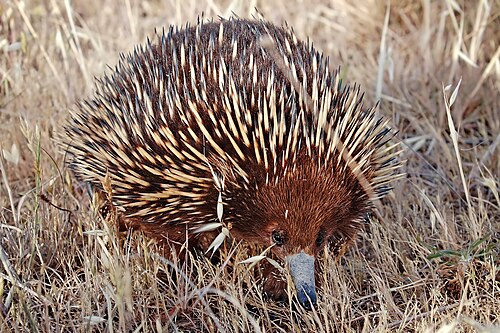



Short-beaked Echidna
Tachyglossus aculeatus
Silhouette: Becky Barnes · PhyloPic
- KingdomAnimalia (Animals)
- PhylumChordata (Chordates)
- ClassMammalia (Mammals)
- OrderMonotremata (Monotremes)
- FamilyTachyglossidae (Echidnas)
- GenusTachyglossus (Short-beaked echidnas)
- SpeciesTachyglossus aculeatus (Short-beaked Echidna)
About the Short-beaked Echidna
The short-beaked echidna (Tachyglossus aculeatus), also known as the common echidna, or short-nosed echidna, is one of four living species of echidna, and the only member of the genus Tachyglossus, from Ancient Greek ταχύς (takhús), meaning "fast", and γλῶσσα (glôssa), meaning "tongue". It is covered in fur and spines and has a distinctive snout and a specialised tongue, which it uses to catch its insect prey at a great speed. Like the other extant monotremes, the short-beaked echidna lays eggs; the monotremes are the only living group of mammals to do so.
The short-beaked echidna has extremely strong front limbs and claws, which allow it to burrow quickly with great power. As it needs to be able to survive underground, it has a significant tolerance to high levels of carbon dioxide and low levels of oxygen. It has no weapons or fighting ability but deters predators by curling into a ball and protecting itself with its spines. It cannot sweat or deal well with heat, so it tends to avoid daytime activity in hot weather. It can swim if needed. The snout has mechanoreceptors and electroreceptors that help the echidna to detect its surroundings.
During the Australian winter, it goes into deep torpor and hibernation, reducing its metabolism to save energy. As the temperature increases, it emerges to mate. Female echidnas lay one egg a year and the mating period is the only time the otherwise solitary animals meet one another; the male has no further contact with the female or his offspring after mating. A newborn echidna is the size of a grape but grows rapidly on its mother's milk, which is very rich in nutrients. By seven weeks baby echidnas grow too large and spiky to stay in the pouch and are expelled into the mother's burrow. At around six months they leave and have no more contact with their mothers.
The species is found throughout Australia, where it is the most widespread native mammal, and in coastal and highland regions of eastern New Guinea, where it is known as the mungwe in the Daribi and Chimbu languages. It is not threatened with extinction, but human activities, such as hunting, habitat destruction, and the introduction of foreign predatory species and parasites, have reduced its abundance in Australia. Wikipedia →
Recent sightings of Short-beaked Echidna in Grampians National Park
LIVEiNaturalistClosest Relatives at Grampians National Park


Global Distribution
Warmer areas are where this animal is recorded most often.
Parks Where Found
| # | Park | Country | Daily sighting probability |
|---|---|---|---|
| 1 | Cradle Mountain-Lake St Clair National Park | 🇦🇺 Australia | |
| 2 | Flinders Ranges National Park | 🇦🇺 Australia | |
| 3 | Flinders Chase | 🇦🇺 Australia | |
| 4 | Maria Island National Park | 🇦🇺 Australia | |
| 5 | Grampians National Park | 🇦🇺 Australia | |
| 6 | Kosciuszko National Park | 🇦🇺 Australia | |
| 7 | Freycinet National Park | 🇦🇺 Australia | |
| 8 | Booderee National Park | 🇦🇺 Australia | |
| 9 | Great Otway National Park | 🇦🇺 Australia | |
| 10 | Wilsons Promontory National Park | 🇦🇺 Australia | |
| 11 | Royal National Park | 🇦🇺 Australia | |
| 12 | Noosa National Park | 🇦🇺 Australia | |
| 13 | Blue Mountains National Park | 🇦🇺 Australia | |
| 14 | Daintree National Park | 🇦🇺 Australia | |
| 15 | Springbrook National Park | 🇦🇺 Australia | |
| 16 | Lamington National Park | 🇦🇺 Australia | |
| 17 | Nitmiluk National Park | 🇦🇺 Australia | |
| 18 | Litchfield National Park | 🇦🇺 Australia | |
| 19 | Cape Range | 🇦🇺 Australia | |
| 20 | Ningaloo Marine Park | 🇦🇺 Australia | |
| 21 | Kakadu National Park | 🇦🇺 Australia |
Quick answers
What are the chances of seeing a Short-beaked Echidna in Grampians National Park?
About 60% of wildlife watchers report a Short-beaked Echidna sighting in Grampians National Park, based on 164 verified sightings from GBIF citizen-science data.
When is the best time to see Short-beaked Echidna in Grampians National Park?
February has the highest sighting rate for Short-beaked Echidna in Grampians National Park in our monthly data.