

Four-toed Salamander
Hemidactylium scutatum
Silhouette: C. Camilo Julián-Caballero · PhyloPic
- KingdomAnimalia (Animals)
- PhylumChordata (Chordates)
- ClassAmphibia (Amphibians)
- OrderCaudata (Salamanders)
- FamilyPlethodontidae (Lungless Salamanders)
- GenusHemidactylium (Four-toed Salamanders)
- SpeciesHemidactylium scutatum (Four-toed Salamander)
About the Four-toed Salamander
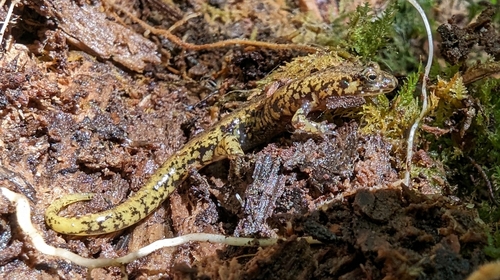
The four-toed salamander (Hemidactylium scutatum) is a lungless salamander native to eastern North America. It is the only species of the monotypic genus Hemidactylium. The four-toed salamander can be recognized by its white underbelly sprinkled with black dots. Its back varies from orange-brownish to red-brownish; its flanks are grayish. The body and the limbs are elongated. The snout is short, and the eyes are prominent. The tail color is usually brighter than the back, and you can observe a constriction at the body/tail junction. The posterior limbs have four toes (hence its name), a good identification criterion but hard to use in the field. This species rarely exceeds 10 cm (3.9 in) in length. In the breeding season (late October to early December) males have enlarged premaxillary teeth and truncated squarish snouts, which are round in females. The juveniles show a tail shorter than the body.
The four-toed salamander can be easily mistaken for the redback salamander (Plethodon cinereus) in the wild. The redback salamander's underbelly has more numerous black markings. Unlike the four-toed salamander, the redback salamander has no constriction at the tail base... Wikipedia →
Recent sightings of Four-toed Salamander in Great Smoky Mountains National Park
LIVEiNaturalistClosest Relatives at Great Smoky Mountains National Park

 Blue Ridge Two-lined Salamander
Eurycea wilderae

 Red-cheeked Salamander
Plethodon jordani

 Spring Salamander
Gyrinophilus porphyriticus

 Seal Salamander
Desmognathus monticola

Imitator Salamander
Desmognathus imitator

Southern Red-backed Salamander
Plethodon serratus

 Red Salamander
Pseudotriton ruber

Pygmy Salamander
Desmognathus wrighti
Cherokee Mountain Dusky Salamander
Desmognathus adatsihi

Northern Slimy Salamander
Plethodon glutinosus

Southern Gray-cheeked Salamander
Plethodon metcalfi

Santeetlah Dusky Salamander
Desmognathus santeetlah
Global Distribution
Warmer areas are where this animal is recorded most often.
Parks Where Found
| # | Park | Country | Daily sighting probability |
|---|---|---|---|
| 1 | Acadia National Park | 🇺🇸 United States | |
| 2 | Cape Breton Highlands National Park | 🇨🇦 Canada | |
| 3 | Shenandoah National Park | 🇺🇸 United States |
Quick answers
What are the chances of seeing a Four-toed Salamander in Great Smoky Mountains National Park?
Under 5% of wildlife watchers report a Four-toed Salamander sighting in Great Smoky Mountains National Park, based on 6 verified sightings from GBIF citizen-science data.
When is the best time to see Four-toed Salamander in Great Smoky Mountains National Park?
February has the highest sighting rate for Four-toed Salamander in Great Smoky Mountains National Park in our monthly data.