


Poisonous Rock Frog
Odorrana hosii
- KingdomAnimalia (Animals)
- PhylumChordata (Chordates)
- ClassAmphibia (Amphibians)
- OrderAnura (Frogs and Toads)
- FamilyRanidae (Typical Frogs)
- GenusOdorrana
- SpeciesOdorrana hosii (Poisonous Rock Frog)
About the Poisonous Rock Frog
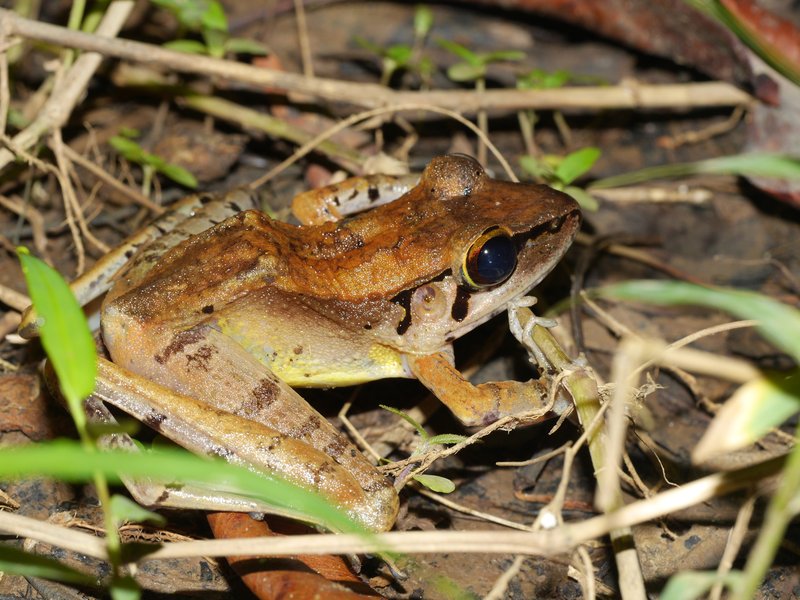
Hose's frog (Odorrana hosii, often misspelled as O. hosei) is a true frog species with a wide range in Southeast Asia. This species was named after zoologist Charles Hose. Its closest living relatives appear to be O. chloronota which occurs to the north of Hose's frog's range, as well as O. livida and O. morafkai with a more limited range in Myanmar and Vietnam, respectively; these four appear to form a close-knit group wherein the northern species are barely closer to each other than Hose's frog is to any of them. Also quite closely related is O. megatympanum, another Vietnamese endemic.
This frog has a robust body with long, slender legs; males measure 50–60 mm, females 85–100 mm. The dorsal are dark green with brown sides, the ventral are pale, the limbs are marked with dark crossbars. Its finger- and toe-tips bear grooved discs.
This frog also have many varians of dorsal colour. Including full green, full brown, green with brown dots, and brown with green dots. Its call heard like "cit" of rats. Its tadpoles apparently lack suctorial discs. Hose's frog has been recorded from the Malay Peninsula south of the Kra Isthmus, on Phuket... Wikipedia →
Closest Relatives at Gunung Leuser National Park

North Sumatra White-lipped Frog
Chalcorana parvaccola

Green Paddy Frog
Hylarana erythraea

Kerinci Cascade Frog
Sumaterana crassiovis
Sumatra Huia Frog
Huia sumatrana

Rough-sided frog
Pulchrana glandulosa

Striped Stream Frog
Pulchrana signata
_Figure_4_(cropped).jpg)
Nicobar Cricket Frog
Amnirana nicobariensis

River Toad
Phrynoidis asper

Common Tree Frog
Polypedates leucomystax

Common Indian Toad
Duttaphrynus melanostictus

Horned Toad
Megophrys nasuta

Alpine Cricket Frog
Fejervarya limnocharis
Global Distribution
Where this species is recorded worldwide. Restricted to human observations from 2019 onwards — the same kind of record and the same period the probabilities on this page are built from, so collar-tracking studies, camera-trap arrays and museum specimens are excluded. Around Santa Rosa that removes 5,924 GPS fixes from a handful of tagged jaguars.
where this species is recorded (GBIF density — it tracks where observers go, not how likely a sighting is) · parks where it occurs — tap a pin for the sighting probability there
Parks Where Found
| # | Park | Country | Daily sighting probability |
|---|---|---|---|
| 1 | Khao Sok National Park | 🇹🇭 Thailand | |
| 2 | Gunung Leuser National Park | 🇮🇩 Indonesia | |
| 3 | Kerinci Seblat National Park | 🇮🇩 Indonesia | |
| 4 | Kinabalu Park | 🇲🇾 Malaysia | |
| 5 | Khao Luang National Park | 🇹🇭 Thailand | |
| 6 | Kinabatangan Wildlife Sanctuary | 🇲🇾 Malaysia |
Quick answers
What are the chances of seeing a Poisonous Rock Frog in Gunung Leuser National Park?
About 30% of wildlife watchers report a Poisonous Rock Frog sighting in Gunung Leuser National Park, based on 36 verified sightings from GBIF citizen-science data.
When is the best time to see Poisonous Rock Frog in Gunung Leuser National Park?
October has the highest sighting rate for Poisonous Rock Frog in Gunung Leuser National Park in our monthly data.