

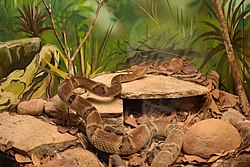


Brazilian Lancehead
Bothrops moojeni
Silhouette: Steven Traver · PhyloPic
- KingdomAnimalia (Animals)
- PhylumChordata (Chordates)
- ClassSquamata
- FamilyViperidae (Vipers)
- GenusBothrops (Neotropical Lanceheads)
- SpeciesBothrops moojeni (Brazilian Lancehead)
About the Brazilian Lancehead
Bothrops moojeni, commonly known in English as the Brazilian lancehead, is a species of highly venomous snake in the family Viperidae. It is a pit viper endemic to South America. The specific name, moojeni, is in honor of Brazilian zoologist João Moojen de Oliveira (1904–1985).
Bothrops moojeni grows to an average total length (tail included) of 1.6 m (5.2 ft), with a maximum of 2.3 m (7.5 ft) already reported. It has a tan, gray-brown or olive-gray color, with 14–21 trapezoidal side markings that are dark gray or completely black. There are 23–29 rows of dorsal scales on the body. The belly is usually white or cream, with scattered dark gray spots. Juveniles have a white tail. The species is terrestrial and nocturnal.
It is considered very defensive. Its body varies from medium to heavy. The broad head is flattened in a lance shape when seen from above, and is distinct from the narrow neck. The snout is not elevated. The eyes are medium in size, with vertically elliptical pupils. The dorsal scales are keeled. B. moojeni is viviparous. Gestation lasts around four months, occurs once a year, and litter size is usually 12–14 neonates. B.... Wikipedia →
Recent sightings of Brazilian Lancehead in Iguazú National Park
LIVEiNaturalist


Global Distribution
Warmer areas are where this animal is recorded most often.
Parks Where Found
| # | Park | Country | Daily sighting probability |
|---|---|---|---|
| 1 | Emas National Park | 🇧🇷 Brazil | |
| 2 | Iguazú National Park | 🇦🇷 Argentina | |
| 3 | Iguaçu National Park | 🇧🇷 Brazil | |
| 4 | Chapada dos Guimarães National Park | 🇧🇷 Brazil | |
| 5 | Serra da Canastra National Park | 🇧🇷 Brazil | |
| 6 | Parque Estadual Encontro das Águas | 🇧🇷 Brazil |
Quick answers
What are the chances of seeing a Brazilian Lancehead in Iguazú National Park?
About 20% of wildlife watchers report a Brazilian Lancehead sighting in Iguazú National Park, based on 27 verified sightings from GBIF citizen-science data.
When is the best time to see Brazilian Lancehead in Iguazú National Park?
August has the highest sighting rate for Brazilian Lancehead in Iguazú National Park in our monthly data.