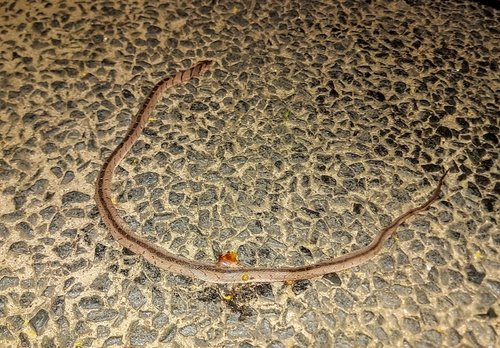

East African Egg Eater
Dasypeltis medici
Silhouette: Alex Slavenko · PhyloPic
- KingdomAnimalia (Animals)
- PhylumChordata (Chordates)
- ClassSquamata
- FamilyColubridae (Colubrid Snakes)
- GenusDasypeltis (Egg-eating Snakes)
- SpeciesDasypeltis medici (East African Egg Eater)
About the East African Egg Eater
Dasypeltis medici, also known commonly as the East African egg-eater, the eastern forest egg-eater, and the rufous egg eater, is a species of nonvenomous snake in the subfamily Colubrinae of the family Colubridae. The species is endemic to Africa.
The specific name, medici, is in honor of Italian physiologist Michele Medici. Dasypeltis medici is found in Eswatini, Kenya, Malawi, Mozambique, Somalia, South Africa, Tanzania, Zambia, and Zimbabwe. The preferred habitat of Dasypeltis medici is lowland evergreen forest, at elevations from near sea level to 2,500 m (8,200 ft).
Dasypeltis medici may attain a snout-to-vent length (SVL) of 76 cm (30 in) for females, and 60 cm (24 in) for males. Dasypeltis medici, like all species in the genus Dasypeltis, feeds exclusively on birds' eggs. It can swallow an egg three times the size of its head. The egg is slit open by vertebral hypapophyses which extend into the esophagus. The collapsed empty shell is regurgitated.
Dasypeltis medici is oviparous. An adult female may lay a clutch of 6–28 elongate eggs, each egg measuring 24 mm × 8 mm (0.94 in... Wikipedia →
Recent sightings of East African Egg Eater in iSimangaliso Wetland Park
LIVEiNaturalistClosest Relatives at iSimangaliso Wetland Park

 Egg-eating Snake
Dasypeltis scabra

Eastern Green Snake
Philothamnus natalensis

Twig Snake
Thelotornis capensis

Red-lipped Snake
Crotaphopeltis hotamboeia

Green Water Snake
Philothamnus hoplogaster

Cross-barred Snake
Dipsadoboa aulica

Spotted Bush Snake
Philothamnus semivariegatus

Boomslang
Dispholidus typus

Common Tiger Snake
Telescopus semiannulatus
Global Distribution
Warmer areas are where this animal is recorded most often.
Parks Where Found
| # | Park | Country | Daily sighting probability |
|---|---|---|---|
| 1 | iSimangaliso Wetland Park | 🇿🇦 South Africa | |
| 2 | Gorongosa National Park | 🇲🇿 Mozambique | |
| 3 | Mkomazi National Park | 🇹🇿 Tanzania | |
| 4 | Tsavo West National Park | 🇰🇪 Kenya | |
| 5 | Tsavo East National Park | 🇰🇪 Kenya |
Quick answers
What are the chances of seeing a East African Egg Eater in iSimangaliso Wetland Park?
About 10% of wildlife watchers report a East African Egg Eater sighting in iSimangaliso Wetland Park, based on 9 verified sightings from GBIF citizen-science data.
When is the best time to see East African Egg Eater in iSimangaliso Wetland Park?
February has the highest sighting rate for East African Egg Eater in iSimangaliso Wetland Park in our monthly data.