

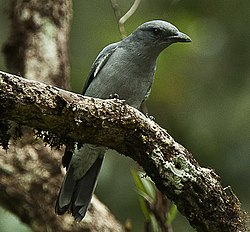


Javan Cuckoo-shrike
Coracina javensis
Silhouette: PhyloPic · PhyloPic
- KingdomAnimalia (Animals)
- PhylumChordata (Chordates)
- ClassAves (Birds)
- OrderPasseriformes (Perching Birds)
- FamilyCampephagidae (Cuckooshrikes)
- GenusCoracina (Typical Cuckooshrikes)
- SpeciesCoracina javensis (Javan Cuckoo-shrike)
About the Javan Cuckoo-shrike
The Oriental cuckooshrike (Coracina javensis) is a species of bird in the family Campephagidae. It is widely distributed from the Himalayas through Southeast Asia to east China and Taiwan. It is also found on the islands of Java and Bali in Indonesia. Its natural habitat is subtropical or tropical moist lowland forest. The range of this species was formerly restricted to Java and Bali and had the English name "Javan cuckooshrike".
Six subspecies are recognised. All except C. j. javensis were formerly considered to be subspecies of the large cuckooshrike (now renamed the Indian cuckooshrike). C. j. javensis (Horsfield, 1821) – Java and Bali C. j. nipalensis (Hodgson, 1836) – Himalayas from north Pakistan to northeast India and Bangladesh
C. j. andamana (Neumann, 1915) – Andaman Islands (west of south Myanmar) C. j. siamensis (Baker, ECS, 1918) – Myanmar and south China (Yunnan) to Thailand and Indochina C. j. larvivora (Hartert, EJO, 1910) – Hainan (off southeast China)
C. j. rexpineti (Swinhoe, 1863) – southeast China, Taiwan, north Laos and north Vietnam Wikipedia →
Recent sightings of Javan Cuckoo-shrike in Jim Corbett National Park
LIVEiNaturalistClosest Relatives at Jim Corbett National Park

 Large Cuckoo-shrike
Coracina macei

Black-winged Cuckooshrike
Coracina melaschistos

Black-headed Cuckooshrike
Coracina melanoptera

Scarlet Minivet
Pericrocotus speciosus

Long-tailed Minivet
Pericrocotus ethologus

Small Minivet
Pericrocotus cinnamomeus

Rosy Minivet
Pericrocotus roseus

Short-billed Minivet
Pericrocotus brevirostris

 White-cheeked Bulbul
Pycnonotus leucogenys

 Jungle Babbler
Turdoides striata

Red-whiskered Bulbul
Pycnonotus jocosus

 Blue Whistling-Thrush
Myophonus caeruleus
Global Distribution
Warmer areas are where this animal is recorded most often.
Parks Where Found
| # | Park | Country | Daily sighting probability |
|---|---|---|---|
| 1 | Bali Barat National Park | 🇮🇩 Indonesia | |
| 2 | Chitwan National Park | 🇳🇵 Nepal | |
| 3 | Royal Bardia National Park | 🇳🇵 Nepal | |
| 4 | Kaziranga National Park | 🇮🇳 India | |
| 5 | Sundarbans National Park | 🇮🇳 India | |
| 6 | Jim Corbett National Park | 🇮🇳 India | |
| 7 | Manas National Park | 🇮🇳 India | |
| 8 | Namdapha National Park | 🇮🇳 India | |
| 9 | Cat Tien National Park | 🇻🇳 Vietnam | |
| 10 | Doi Inthanon National Park | 🇹🇭 Thailand | |
| 11 | Royal Manas National Park | 🇧🇹 Bhutan | |
| 12 | Cuc Phuong National Park | 🇻🇳 Vietnam |
Quick answers
What are the chances of seeing a Javan Cuckoo-shrike in Jim Corbett National Park?
About 10% of wildlife watchers report a Javan Cuckoo-shrike sighting in Jim Corbett National Park, based on 217 verified sightings from GBIF citizen-science data.
When is the best time to see Javan Cuckoo-shrike in Jim Corbett National Park?
February has the highest sighting rate for Javan Cuckoo-shrike in Jim Corbett National Park in our monthly data.