


Double-barred Finch
Taeniopygia bichenovii
Silhouette: Jim Bendon (photography) and T. Michael Keesey (vectorization) · PhyloPic
- KingdomAnimalia (Animals)
- PhylumChordata (Chordates)
- ClassAves (Birds)
- OrderPasseriformes (Perching Birds)
- FamilyEstrildidae (Waxbills and Allies)
- GenusTaeniopygia (Zebra Finches)
- SpeciesTaeniopygia bichenovii (Double-barred Finch)
About the Double-barred Finch
The double-barred finch (Stizoptera bichenovii) is an estrildid finch found in dry savannah, tropical (lowland) dry grassland and shrubland habitats in northern and eastern Australia. It is sometimes referred to as Bicheno's finch or as the owl finch, the latter of which owing to the dark ring of feathers around the face. It is the only species placed in the genus Stizoptera.
The double-barred finch was formally described in 1827 by the naturalists Nicholas Vigors and Thomas Horsfield from specimens collected near Shoalwater Bay and Broad Sound in Queensland, Australia. They coined the binomial name Fringilla bichenovii. The species was formerly placed in the genus Taeniopygia. A molecular phylogenetic study of the Estrildidae published in 2020 found that the genus Taeniopygia was not monophyletic. In the reorganization to create monophyletic genera, the double-barred finch was moved to the resurrected genus Stizoptera that had been introduced in 1899 by the American ornithologist Harry C. Oberholser. The genus name combines the Ancient Greek stizō meaning "to tattoo" with pteron meaning "wing". The specific epithet commemorates James Ebenezer Bicheno, a colonial secretary... Wikipedia →
Recent sightings of Double-barred Finch in Kakadu National Park
LIVEiNaturalistClosest Relatives at Kakadu National Park

 Zebra Finch
Taeniopygia guttata

 Crimson Finch
Neochmia phaeton

Long-tailed Finch
Poephila acuticauda

Masked Finch
Poephila personata

 Chestnut-breasted Munia
Lonchura castaneothorax
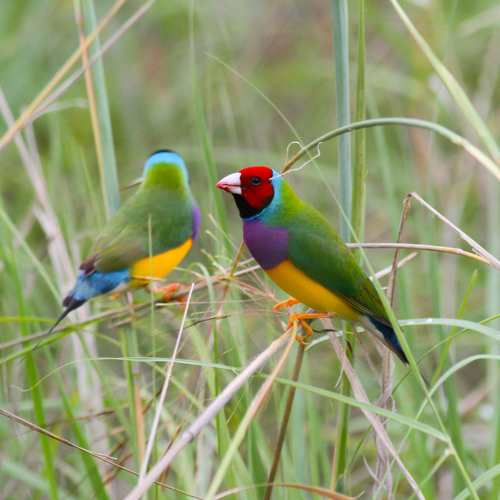
 Gouldian Finch
Erythrura gouldiae

 Torresian Crow
Corvus orru

 Willie Wagtail
Rhipidura leucophrys

 White-bellied Cuckooshrike
Coracina papuensis

 Green Oriole
Oriolus flavocinctus

Paperbark Flycatcher
Myiagra nana

 White-gaped Honeyeater
Stomiopera unicolor
Global Distribution
Warmer areas are where this animal is recorded most often.
Parks Where Found
| # | Park | Country | Daily sighting probability |
|---|---|---|---|
| 1 | Nitmiluk National Park | 🇦🇺 Australia | |
| 2 | Kakadu National Park | 🇦🇺 Australia | |
| 3 | Litchfield National Park | 🇦🇺 Australia | |
| 4 | Blue Mountains National Park | 🇦🇺 Australia | |
| 5 | Daintree National Park | 🇦🇺 Australia | |
| 6 | Royal National Park | 🇦🇺 Australia | |
| 7 | Kosciuszko National Park | 🇦🇺 Australia | |
| 8 | Lamington National Park | 🇦🇺 Australia |
Quick answers
What are the chances of seeing a Double-barred Finch in Kakadu National Park?
About 30% of wildlife watchers report a Double-barred Finch sighting in Kakadu National Park, based on 529 verified sightings from GBIF citizen-science data.
When is the best time to see Double-barred Finch in Kakadu National Park?
December has the highest sighting rate for Double-barred Finch in Kakadu National Park in our monthly data.