


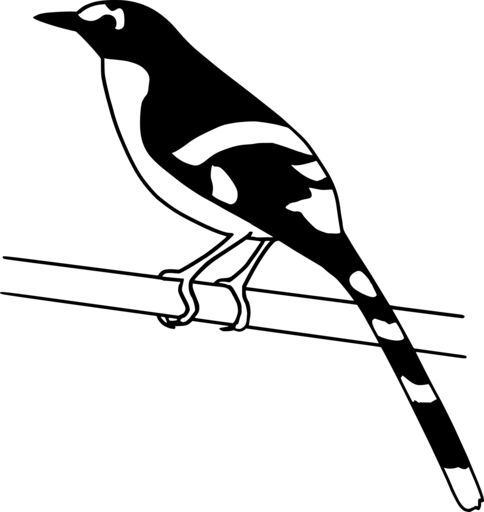
Slaty-backed Forktail
Enicurus schistaceus
Silhouette: Andy Wilson · PhyloPic
- KingdomAnimalia (Animals)
- PhylumChordata (Chordates)
- ClassAves (Birds)
- OrderPasseriformes (Perching Birds)
- FamilyMuscicapidae (Old World Flycatchers, Robins, and Chats)
- GenusEnicurus (Forktails)
- SpeciesEnicurus schistaceus (Slaty-backed Forktail)
About the Slaty-backed Forktail
The slaty-backed forktail (Enicurus schistaceus) is a species of forktail in the family Muscicapidae. A slim, medium-sized forktail, it is distinguished from similar species by its slate grey forehead, crown, and mantle. It has a long and deeply forked tail banded in black and white, a white rump, and a white bar across its primary feathers; the rest of the plumage is predominantly white. The sexes look alike. The bird frequents the edges of fast-flowing streams and rivers, where it hunts small invertebrates by hopping among rocks or flying out over the water. It breeds between February and July, laying 3–4 pinkish, bluish, or white eggs; both sexes incubate the eggs.
The slaty-backed forktail is found near streams and rivers in tropical and subtropical regions, occasionally straying further from flowing water to the edges of roads and trails. Generally a solitary bird, it may occasionally be found in pairs, or in family groups in the breeding season. One of its calls has been described as similar to that of the Blyth's kingfisher, for which it has been mistaken. The forktail is found in the central and eastern Himalayas, the Indian Sub-continent, southern China and continental Southeast Asia. Its wide distribution and apparently stable population have led to it being classified as a species of least concern by the International Union for Conservation of Nature. Wikipedia →
Recent sightings of Slaty-backed Forktail in Khao Yai National Park
LIVEiNaturalistClosest Relatives at Khao Yai National Park

 White-crowned Forktail
Enicurus leschenaulti

 Taiga Flycatcher
Ficedula albicilla

 White-rumped Shama
Copsychus malabaricus

 Asian Brown Flycatcher
Muscicapa latirostris

Verditer Flycatcher
Eumyias thalassinus

Blue Rock-Thrush
Monticola solitarius

 Hill Blue Flycatcher
Cyornis whitei

Hainan Blue-Flycatcher
Cyornis hainanus

 Amur Stonechat
Saxicola stejnegeri

Blue Whistling-Thrush
Myophonus caeruleus

Oriental Magpie-Robin
Copsychus saularis

Javan Blue Flycatcher
Cyornis banyumas
Global Distribution
Warmer areas are where this animal is recorded most often.
Parks Where Found
| # | Park | Country | Daily sighting probability |
|---|---|---|---|
| 1 | Namdapha National Park | 🇮🇳 India | |
| 2 | Royal Manas National Park | 🇧🇹 Bhutan | |
| 3 | Doi Inthanon National Park | 🇹🇭 Thailand | |
| 4 | Khangchendzonga National Park | 🇮🇳 India | |
| 5 | Khao Yai National Park | 🇹🇭 Thailand | |
| 6 | Manas National Park | 🇮🇳 India | |
| 7 | Kaeng Krachan National Park | 🇹🇭 Thailand | |
| 8 | Cuc Phuong National Park | 🇻🇳 Vietnam | |
| 9 | Khao Luang National Park | 🇹🇭 Thailand | |
| 10 | Chitwan National Park | 🇳🇵 Nepal | |
| 11 | Taman Negara National Park | 🇲🇾 Malaysia | |
| 12 | Jim Corbett National Park | 🇮🇳 India |
Quick answers
What are the chances of seeing a Slaty-backed Forktail in Khao Yai National Park?
Under 5% of wildlife watchers report a Slaty-backed Forktail sighting in Khao Yai National Park, based on 98 verified sightings from GBIF citizen-science data.
When is the best time to see Slaty-backed Forktail in Khao Yai National Park?
December has the highest sighting rate for Slaty-backed Forktail in Khao Yai National Park in our monthly data.