



Asian Glossy Starling
Aplonis panayensis
Silhouette: Rafael Maia · PhyloPic
- KingdomAnimalia (Animals)
- PhylumChordata (Chordates)
- ClassAves (Birds)
- OrderPasseriformes (Perching Birds)
- FamilySturnidae (Starlings)
- GenusAplonis (Pacific Starlings)
- SpeciesAplonis panayensis (Asian Glossy Starling)
About the Asian Glossy Starling
The Asian glossy starling (Aplonis panayensis) is a species of starling in the family Sturnidae. It is found in Bangladesh, Brunei, northeastern India (Assam), Indonesia, Malaysia, Myanmar, the Philippines, Singapore, Cambodia and Thailand. Its natural habitats are subtropical or tropical moist lowland forest and subtropical or tropical mangrove forest. It has also been introduced to Taiwan.
It is 20 cm long, and weighs 50–60 g. Adults (both sexes) have glossy black plumage; juveniles are blackish-brown above, whitish heavily streaked with dark brown below. The iris is bright red in adults, except for A. p. albiris, which has a white eye; in juveniles it is yellow, orange, or pink. The subspecies vary in extent and intensity of the plumage gloss, and in the size of the bill.
The following subspecies are recognised by the International Ornithological Congress: A. p. affinis (Blyth, 1876) – northeastern India, Bangladesh, southwestern Myanmar A. p. tytleri (Hume, 1873) – Andaman and north Nicobar Islands
A. p. albiris Abdulali, 1967 – central and southern Nicobar Islands A. p. strigata (Horsfield, 1821) – Malay Peninsula, Sumatra, Java, and west Borneo... Wikipedia →
Recent sightings of Asian Glossy Starling in Kinabatangan Wildlife Sanctuary
LIVEiNaturalistClosest Relatives at Kinabatangan Wildlife Sanctuary

 Javan Myna
Acridotheres javanicus

 Common Hill Myna
Gracula religiosa

Crested Myna
Acridotheres cristatellus

 Slender-billed Crow
Corvus enca

 Black-and-red Broadbill
Cymbirhynchus macrorhynchos

Ashy Tailorbird
Orthotomus ruficeps

 Malaysian Pied-Fantail
Rhipidura javanica

 White-crowned Shama
Copsychus stricklandii
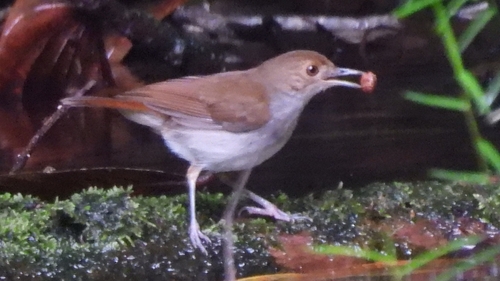
 White-chested Babbler
Trichastoma rostratum

Black-and-yellow Broadbill
Eurylaimus ochromalus

 Malaysian Blue-Flycatcher
Cyornis turcosus

 Hooded Pitta
Pitta sordida
Global Distribution
Warmer areas are where this animal is recorded most often.
Parks Where Found
| # | Park | Country | Daily sighting probability |
|---|---|---|---|
| 1 | Bako National Park | 🇲🇾 Malaysia | |
| 2 | Sepilok | 🇲🇾 Malaysia | |
| 3 | Kinabatangan Wildlife Sanctuary | 🇲🇾 Malaysia | |
| 4 | Taman Negara National Park | 🇲🇾 Malaysia | |
| 5 | Kinabalu Park | 🇲🇾 Malaysia | |
| 6 | Khao Luang National Park | 🇹🇭 Thailand | |
| 7 | Danum Valley Conservation Area | 🇲🇾 Malaysia | |
| 8 | Gunung Leuser National Park | 🇮🇩 Indonesia | |
| 9 | Kerinci Seblat National Park | 🇮🇩 Indonesia | |
| 10 | Bali Barat National Park | 🇮🇩 Indonesia | |
| 11 | Khao Sok National Park | 🇹🇭 Thailand |
Quick answers
What are the chances of seeing a Asian Glossy Starling in Kinabatangan Wildlife Sanctuary?
About 20% of wildlife watchers report a Asian Glossy Starling sighting in Kinabatangan Wildlife Sanctuary, based on 467 verified sightings from GBIF citizen-science data.
When is the best time to see Asian Glossy Starling in Kinabatangan Wildlife Sanctuary?
February has the highest sighting rate for Asian Glossy Starling in Kinabatangan Wildlife Sanctuary in our monthly data.