



Malaysian Pied-Fantail
Rhipidura javanica
Silhouette: Michael Scroggie · PhyloPic
- KingdomAnimalia (Animals)
- PhylumChordata (Chordates)
- ClassAves (Birds)
- OrderPasseriformes (Perching Birds)
- FamilyRhipiduridae (Fantails)
- GenusRhipidura (Fantails)
- SpeciesRhipidura javanica (Malaysian Pied-Fantail)
About the Malaysian Pied-Fantail
The Sunda pied fantail (Rhipidura javanica), also known as the Malaysian pied fantail, is a species of bird in the fantail family. It is locally referred to as murai gila, literally "crazy thrush" in the Malay language. It was previously considered conspecific with the Philippine pied fantail.
It is found in Brunei, Cambodia, Indonesia, Laos, Malaysia, Myanmar, Singapore, Thailand, and Vietnam. It inhabits a wide variety of forest and scrub, including parks, agricultural lands, and other degraded habitat. It resides in lowland areas, sometimes up to 800m in elevation, and is usually found near water.
The Sunda pied fantail eats insects caught on the wing. It often joins mixed feeding flocks with other insectivorous birds, and will sometimes follow large mammals to eat insects stirred up by their movement. It breeds from January to August, varying across its range. It constructs a cup nest from fibers and grasses held together with spiderweb.
It is not known to migrate. The IUCN considers the Sunda pied fantail of Least Concern because of its wide geographic range and large, stable population. Wikipedia →
Recent sightings of Malaysian Pied-Fantail in Kinabatangan Wildlife Sanctuary
LIVEiNaturalistClosest Relatives at Kinabatangan Wildlife Sanctuary

 Spotted Fantail
Rhipidura perlata

White-throated Fantail
Rhipidura albicollis

 Slender-billed Crow
Corvus enca

 Black-and-red Broadbill
Cymbirhynchus macrorhynchos

 Javan Myna
Acridotheres javanicus

Ashy Tailorbird
Orthotomus ruficeps

 White-crowned Shama
Copsychus stricklandii
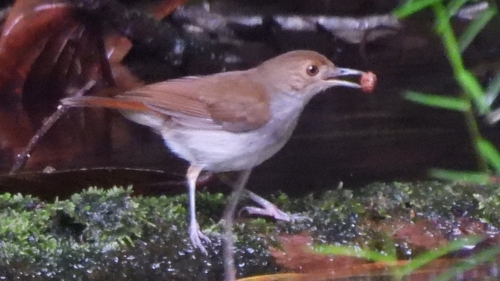
 White-chested Babbler
Trichastoma rostratum

Black-and-yellow Broadbill
Eurylaimus ochromalus

 Malaysian Blue-Flycatcher
Cyornis turcosus

 Hooded Pitta
Pitta sordida

 Common Hill Myna
Gracula religiosa
Global Distribution
Warmer areas are where this animal is recorded most often.
Parks Where Found
| # | Park | Country | Daily sighting probability |
|---|---|---|---|
| 1 | Tanjung Puting National Park | 🇮🇩 Indonesia | |
| 2 | Bali Barat National Park | 🇮🇩 Indonesia | |
| 3 | Danum Valley Conservation Area | 🇲🇾 Malaysia | |
| 4 | Kinabatangan Wildlife Sanctuary | 🇲🇾 Malaysia | |
| 5 | Sepilok | 🇲🇾 Malaysia | |
| 6 | Kaeng Krachan National Park | 🇹🇭 Thailand | |
| 7 | Way Kambas National Park | 🇮🇩 Indonesia | |
| 8 | Khao Yai National Park | 🇹🇭 Thailand | |
| 9 | Kinabalu Park | 🇲🇾 Malaysia | |
| 10 | Gunung Leuser National Park | 🇮🇩 Indonesia | |
| 11 | Taman Negara National Park | 🇲🇾 Malaysia | |
| 12 | Bako National Park | 🇲🇾 Malaysia | |
| 13 | Khao Luang National Park | 🇹🇭 Thailand | |
| 14 | Kerinci Seblat National Park | 🇮🇩 Indonesia | |
| 15 | Khao Sok National Park | 🇹🇭 Thailand | |
| 16 | Cat Tien National Park | 🇻🇳 Vietnam | |
| 17 | Doi Inthanon National Park | 🇹🇭 Thailand |
Quick answers
What are the chances of seeing a Malaysian Pied-Fantail in Kinabatangan Wildlife Sanctuary?
About 40% of wildlife watchers report a Malaysian Pied-Fantail sighting in Kinabatangan Wildlife Sanctuary, based on 1,070 verified sightings from GBIF citizen-science data.
When is the best time to see Malaysian Pied-Fantail in Kinabatangan Wildlife Sanctuary?
June has the highest sighting rate for Malaysian Pied-Fantail in Kinabatangan Wildlife Sanctuary in our monthly data.