

Chestnut-winged Babbler
Stachyris erythroptera
Silhouette: Jiekun He · PhyloPic
- KingdomAnimalia (Animals)
- PhylumChordata (Chordates)
- ClassAves (Birds)
- OrderPasseriformes (Perching Birds)
- FamilyTimaliidae (Tree-Babblers, Scimitar-Babblers, and Allies)
- GenusStachyris (Typical Tree-Babblers)
- SpeciesStachyris erythroptera (Chestnut-winged Babbler)
About the Chestnut-winged Babbler
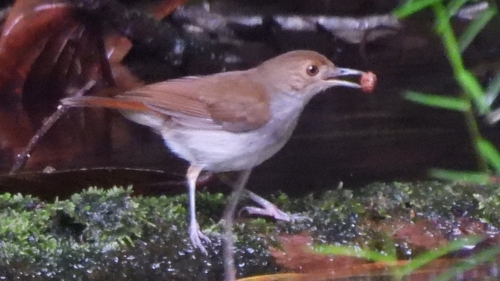
The chestnut-winged babbler (Cyanoderma erythropterum) is a babbler species in the family Timaliidae. The chestnut-winged babbler is chestnut-brown with a greyish face and underparts, and is 12.5–13.5 cm (4.9–5.3 in) long. It feeds on small Coleoptera beetles, Phasmida insects, ants, and Hemiptera bugs. Its foraging strategy is gleaning.
Timalia erythroptera was the scientific name proposed by Edward Blyth in 1842 for an olive-brown babbler from Nepal. It was later placed in the genus Stachyris, but since 2020 is recognised as a Cyanoderma species. The grey-hooded babbler (C. bicolor) of Borneo was formerly considered conspecific.
The chestnut-winged babbler occurs in the Malay Peninsula from southern Thailand to Singapore, and in Sumatra. It inhabits forests and shrublands up to an elevation of 800 m (2,600 ft). It is listed as Least Concern on the IUCN Red List.
BirdLife International (2019). "Chestnut-winged Babbler Cyanoderma erythropterum". "Photos of Chestnut-winged Babbler Cyanoderma erythropterum". The Internet Bird Collection. Wikipedia →
Recent sightings of Chestnut-winged Babbler in Kinabatangan Wildlife Sanctuary
LIVEiNaturalistClosest Relatives at Kinabatangan Wildlife Sanctuary

 Black-throated Babbler
Stachyris nigricollis

Chestnut-rumped Babbler
Stachyris maculata

Gray-headed Babbler
Stachyris poliocephala

Fluffy-backed Tit-Babbler
Macronus ptilosus

 Slender-billed Crow
Corvus enca

Black-and-red Broadbill
Cymbirhynchus macrorhynchos

 Javan Myna
Acridotheres javanicus

Ashy Tailorbird
Orthotomus ruficeps

 Malaysian Pied-Fantail
Rhipidura javanica

 White-crowned Shama
Copsychus stricklandii
 White-chested Babbler
Trichastoma rostratum

Black-and-yellow Broadbill
Eurylaimus ochromalus
Global Distribution
Warmer areas are where this animal is recorded most often.
Parks Where Found
| # | Park | Country | Daily sighting probability |
|---|---|---|---|
| 1 | Khao Luang National Park | 🇹🇭 Thailand | |
| 2 | Danum Valley Conservation Area | 🇲🇾 Malaysia | |
| 3 | Taman Negara National Park | 🇲🇾 Malaysia | |
| 4 | Sepilok | 🇲🇾 Malaysia | |
| 5 | Way Kambas National Park | 🇮🇩 Indonesia | |
| 6 | Khao Sok National Park | 🇹🇭 Thailand | |
| 7 | Bako National Park | 🇲🇾 Malaysia | |
| 8 | Kinabatangan Wildlife Sanctuary | 🇲🇾 Malaysia | |
| 9 | Gunung Leuser National Park | 🇮🇩 Indonesia | |
| 10 | Kinabalu Park | 🇲🇾 Malaysia | |
| 11 | Kerinci Seblat National Park | 🇮🇩 Indonesia |
Quick answers
What are the chances of seeing a Chestnut-winged Babbler in Kinabatangan Wildlife Sanctuary?
About 10% of wildlife watchers report a Chestnut-winged Babbler sighting in Kinabatangan Wildlife Sanctuary, based on 236 verified sightings from GBIF citizen-science data.
When is the best time to see Chestnut-winged Babbler in Kinabatangan Wildlife Sanctuary?
August has the highest sighting rate for Chestnut-winged Babbler in Kinabatangan Wildlife Sanctuary in our monthly data.