

Garnot's House Gecko
Hemidactylus garnotii
Silhouette: Alex Slavenko · PhyloPic
- KingdomAnimalia (Animals)
- PhylumChordata (Chordates)
- ClassSquamata
- FamilyGekkonidae (Typical Geckos)
- GenusHemidactylus (House Geckos)
- SpeciesHemidactylus garnotii (Garnot's House Gecko)
About the Garnot's House Gecko
The Indo-Pacific gecko (Hemidactylus garnotii), also known as Garnot's house gecko, fox gecko, or the Assam greyish-brown gecko, is a species of gecko native to South and Southeast Asia, Polynesia, and the east coast of Australia.
Adults grow to about 10–13 cm (4–5 in) in length. Similar to H. frenatus, they exhibit the ability to change the colour of their skin, from dark gray or brown with light markings in daylight, to a pale, translucent colour at night. Often mistaken for a common house gecko, the species can be distinguished by its rows of large, spiny scales on the lateral edges of the tail.
The species epithet, garnotii, is named in honor of the French naturalist Prosper Garnot. The name gecko is onomatopoeic, in reference to the chirp of H. frenatus, one of three extant relatives of H. garnotii, which has historically been interpreted as a "gecko, gecko" sound. The common name fox gecko relates to the species' long, narrow snout, similar to that of a fox.
The Indo-Pacific gecko bears a striking resemblance to its extant cousin H. frenatus, its closest relative. However, individuals of H. garnotii tend to be much larger than H. frenatus, with... Wikipedia →
Recent sightings of Garnot's House Gecko in Kinabatangan Wildlife Sanctuary
LIVEiNaturalistClosest Relatives at Kinabatangan Wildlife Sanctuary

 Flat-tailed House Gecko
Hemidactylus platyurus

 Common House Gecko
Hemidactylus frenatus

 White-banded Narrow-disked Gecko
Gekko albofasciolatus

Spotted House Gecko
Gekko monarchus

 Mutilating Gecko
Gehyra mutilata

 Gliding gecko
Gekko kuhli
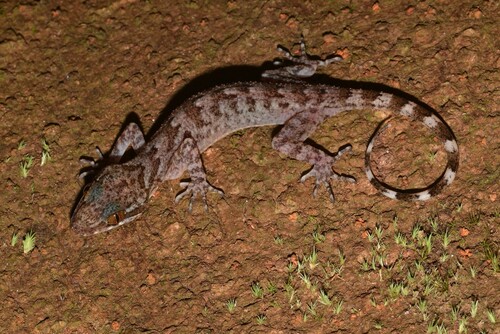
 Sabah Lowland Bent-toed Gecko
Cyrtodactylus yoshii

Horsfield's Flying Gecko
Gekko horsfieldii
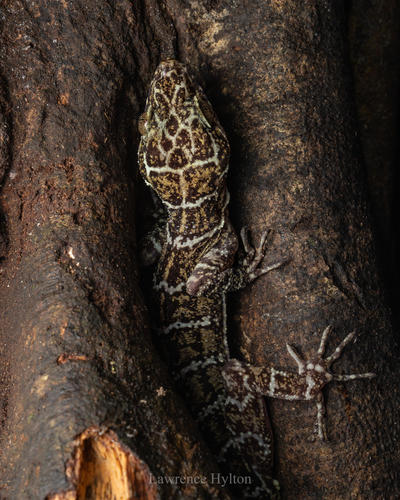
Borneo Bow-fingered Gecko
Cyrtodactylus malayanus

 Common Dwarf Gecko
Hemiphyllodactylus typus
Global Distribution
Warmer areas are where this animal is recorded most often.
Parks Where Found
| # | Park | Country | Daily sighting probability |
|---|---|---|---|
| 1 | Kinabatangan Wildlife Sanctuary | 🇲🇾 Malaysia | |
| 2 | Khao Yai National Park | 🇹🇭 Thailand | |
| 3 | Kaeng Krachan National Park | 🇹🇭 Thailand | |
| 4 | Everglades National Park | 🇺🇸 United States | |
| 5 | Cuc Phuong National Park | 🇻🇳 Vietnam | |
| 6 | Khao Sok National Park | 🇹🇭 Thailand | |
| 7 | Khao Luang National Park | 🇹🇭 Thailand | |
| 8 | Chirripó National Park | 🇨🇷 Costa Rica | |
| 9 | Bako National Park | 🇲🇾 Malaysia | |
| 10 | Rincón de la Vieja National Park | 🇨🇷 Costa Rica | |
| 11 | Bali Barat National Park | 🇮🇩 Indonesia | |
| 12 | Kinabalu Park | 🇲🇾 Malaysia | |
| 13 | Doi Inthanon National Park | 🇹🇭 Thailand | |
| 14 | Ostional Wildlife Refuge | 🇨🇷 Costa Rica | |
| 15 | Big Cypress National Preserve | 🇺🇸 United States | |
| 16 | Monteverde Cloud Forest Reserve | 🇨🇷 Costa Rica | |
| 17 | Royal National Park | 🇦🇺 Australia | |
| 18 | Tapantí-Macizo de la Muerte National Park | 🇨🇷 Costa Rica |
Quick answers
What are the chances of seeing a Garnot's House Gecko in Kinabatangan Wildlife Sanctuary?
About 10% of wildlife watchers report a Garnot's House Gecko sighting in Kinabatangan Wildlife Sanctuary, based on 6 verified sightings from GBIF citizen-science data.
When is the best time to see Garnot's House Gecko in Kinabatangan Wildlife Sanctuary?
March has the highest sighting rate for Garnot's House Gecko in Kinabatangan Wildlife Sanctuary in our monthly data.