
Beach Thick-knee
Esacus magnirostris
- KingdomAnimalia (Animals)
- PhylumChordata (Chordates)
- ClassAves (Birds)
- OrderCharadriiformes (Shorebirds and Allies)
- FamilyBurhinidae (Stone-curlews and Thick-knees)
- GenusEsacus (Greater Stone-curlews)
- SpeciesEsacus magnirostris (Beach Thick-knee)
About the Beach Thick-knee
The beach stone-curlew (Esacus magnirostris) or beach thick-knee is a large, ground-dwelling bird that occurs in Australasia, the islands of South-east Asia. At 55 cm (22 in) and 1 kg (2.2 lb), it is one of the world's largest shorebirds.
It is less strictly nocturnal than most stone-curlews, and can sometimes be seen foraging by daylight, moving slowly and deliberately, with occasional short runs. It tends to be wary and fly off into the distance ahead of the observer, employing slow, rather stiff wingbeats..
The beach stone-curlew is classified as Near Threatened on the IUCN Red List of Threatened Species. In New South Wales, it is listed as critically endangered. The beach stone-curlew is a resident of undisturbed open beaches, exposed reefs, mangroves, and tidal sand or mudflats over a large range, including coastal eastern Australia as far south as far eastern Victoria, the northern Australian coast and nearby islands, New Guinea, New Caledonia, Indonesia, Malaysia, and the Philippines. It is uncommon over most of its range, and rare south of Cairns.
The beach stone-curlew is 54-56 cm (21-22 in) long. At a mean of 1,032 g (2.275 lb) in males... Wikipedia →
Closest Relatives at Komodo National Park

Crested Tern
Thalasseus bergii

Black-naped Tern
Sterna sumatrana

Red-necked Phalarope
Phalaropus lobatus
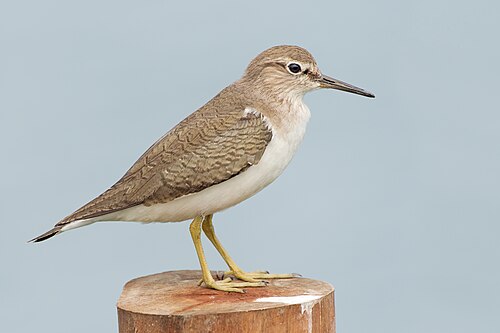
Common Sandpiper
Actitis hypoleucos

Bridled Tern
Onychoprion anaethetus

Whimbrel
Numenius phaeopus

Lesser Crested Tern
Thalasseus bengalensis

Common Tern
Sterna hirundo

Brown Noddy
Anous stolidus

Little Tern
Sternula albifrons

Roseate Tern
Sterna dougallii

Sanderling
Calidris alba
Global Distribution
Where this species is recorded worldwide. Restricted to human observations from 2019 onwards — the same kind of record and the same period the probabilities on this page are built from, so collar-tracking studies, camera-trap arrays and museum specimens are excluded. Around Santa Rosa that removes 5,924 GPS fixes from a handful of tagged jaguars.
where this species is recorded (GBIF density — it tracks where observers go, not how likely a sighting is) · parks where it occurs — tap a pin for the sighting probability there
Parks Where Found
| # | Park | Country | Daily sighting probability |
|---|---|---|---|
| 1 | Daintree National Park | 🇦🇺 Australia | |
| 2 | Bali Barat National Park | 🇮🇩 Indonesia | |
| 3 | Ningaloo Marine Park | 🇦🇺 Australia | |
| 4 | Raja Ampat | 🇮🇩 Indonesia | |
| 5 | Kerinci Seblat National Park | 🇮🇩 Indonesia | |
| 6 | Cape Range | 🇦🇺 Australia | |
| 7 | Tangkoko Nature Reserve | 🇮🇩 Indonesia | |
| 8 | Booderee National Park | 🇦🇺 Australia |
Quick answers
What are the chances of seeing a Beach Thick-knee in Komodo National Park?
About 10% of wildlife watchers report a Beach Thick-knee sighting in Komodo National Park, based on 31 verified sightings from GBIF citizen-science data.
When is the best time to see Beach Thick-knee in Komodo National Park?
August has the highest sighting rate for Beach Thick-knee in Komodo National Park in our monthly data.