


Sanderling
Calidris alba
- KingdomAnimalia (Animals)
- PhylumChordata (Chordates)
- ClassAves (Birds)
- OrderCharadriiformes (Shorebirds and Allies)
- FamilyScolopacidae (Sandpipers and Allies)
- GenusCalidris (Calidris Sandpipers)
- SpeciesCalidris alba (Sanderling)
About the Sanderling
The sanderling (Calidris alba) is a small wading bird. It is a circumpolar Arctic breeder, being among the most extreme northern breeding birds in the world, nesting only on the coldest tundra, north of the 5°C July isotherm; in Europe, its southernmost breeding locality is Svalbard, where only a handful (5–15) pairs breed. It is a long-distance migrant, wintering south to South America, western and southern Europe, Africa, and Australia. It is highly gregarious in winter, sometimes forming large flocks on coastal mudflats or sandy beaches.
It is somewhat unlike other small sandpipers in appearance, in particular in lacking a hind toe, which has led to the suggestion that it should be placed into a monotypic genus Crocethia. More recent reviews indicate that the sanderling is a fairly typical "stint" or small sandpiper and should be retained along with the knots and other relatives in the genus Calidris.
This bird is similar in size to a dunlin, but stouter, with a thick bill. It shows a strong white wingbar in flight, and runs along the sandy beaches it prefers with a characteristic "bicycling" action of its legs, stopping frequently to pick small food items. It eats small crabs and other small invertebrates. In spring, birds migrating north from South America consume large numbers of horseshoe crab eggs in the Delaware Bay area.
In spring, the birds arrive on their High Arctic breeding grounds (see map) at the end of May or in early June, where they lay 3–4 eggs in a ground scrape from mid June to mid July. On the nesting grounds, these birds mainly eat insects and some plant material.
The sanderling was described by the German naturalist Peter Simon Pallas in 1764 and given the binomial name Trynga alba. The sanderling is one of the species to which the Agreement on the Conservation of African-Eurasian Migratory Waterbirds (AEWA) applies. Wikipedia →
Closest Relatives at Komodo National Park

Red-necked Phalarope
Phalaropus lobatus
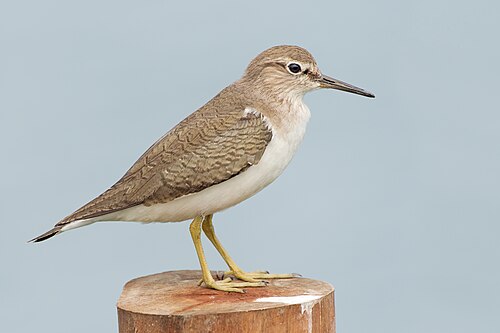
Common Sandpiper
Actitis hypoleucos

Whimbrel
Numenius phaeopus

Ruddy Turnstone
Arenaria interpres

Wood Sandpiper
Tringa glareola

Crested Tern
Thalasseus bergii

Black-naped Tern
Sterna sumatrana

Beach Thick-knee
Esacus magnirostris

Bridled Tern
Onychoprion anaethetus

Lesser Crested Tern
Thalasseus bengalensis

Common Tern
Sterna hirundo

Brown Noddy
Anous stolidus
Global Distribution
Where this species is recorded worldwide. Restricted to human observations from 2019 onwards — the same kind of record and the same period the probabilities on this page are built from, so collar-tracking studies, camera-trap arrays and museum specimens are excluded. Around Santa Rosa that removes 5,924 GPS fixes from a handful of tagged jaguars.
where this species is recorded (GBIF density — it tracks where observers go, not how likely a sighting is) · parks where it occurs — tap a pin for the sighting probability there