


Blacktip Reef Shark
Carcharhinus melanopterus
- KingdomAnimalia (Animals)
- PhylumChordata (Chordates)
- ClassElasmobranchii
- OrderCarcharhiniformes (Ground Sharks)
- FamilyCarcharhinidae (Requiem Sharks)
- GenusCarcharhinus (Typical Requiem Sharks)
- SpeciesCarcharhinus melanopterus (Blacktip Reef Shark)
About the Blacktip Reef Shark
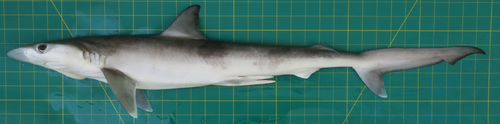
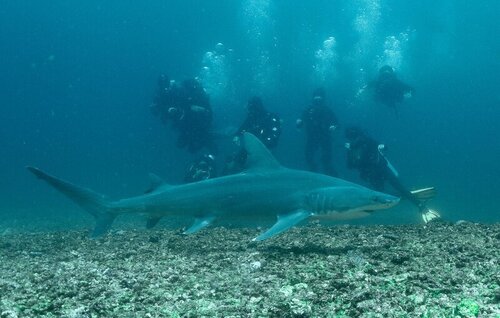
The blacktip reef shark (Carcharhinus melanopterus) is a species of requiem shark, in the family Carcharhinidae, which can be easily identified by the prominent black tips on its fins (especially on the first dorsal fin and its caudal fin). Among the most abundant sharks inhabiting the tropical coral reefs of the Indian and Pacific Oceans, this species prefers shallow, inshore waters. Its exposed first dorsal fin is a common sight in the region. The blacktip reef shark is usually found over reef ledges and sandy flats, though it has also been known to enter brackish and freshwater environments. It typically attains a length of 1.6 m (5.2 ft). Like other sharks, the females are larger than the males.
The blacktip reef shark has extremely small home ranges and exhibits strong site fidelity, remaining within the same local area for up to several years at a time. It is an active predator of small bony fish, cephalopods, and crustaceans, and has also been known to feed on sea snakes and seabirds. Accounts of the blacktip reef shark's life history have been variable and sometimes contradictory, in part reflecting geographical differences within the species. Like other members of its family, this shark is viviparous, with females giving birth to two to five young on a biennial, annual, or possibly biannual cycle. Reports of the gestation period range from 7–9, through 10–11, to possibly 16 months. Mating is preceded by the male following closely behind the female, likely attracted by her chemical signals. Newborn sharks are found further inshore and in shallower water than adults, frequently roaming in large groups over areas flooded by high tide.
Timid and skittish, the blacktip reef shark is difficult to approach and seldom poses a danger to humans unless roused by food. However, people wading through shallow water are at risk of having their legs mistakenly bitten. This shark is used for its meat, fins, and liver oil, but is not considered to be a commercially significant species. The International Union for Conservation of Nature has assessed the blacktip reef shark as Vulnerable. Although the species as a whole remains widespread and relatively common, overfishing of this slow-reproducing shark has led to its decline at a number of locales. Wikipedia →



Global Distribution
Where this species is recorded worldwide. Restricted to human observations from 2019 onwards — the same kind of record and the same period the probabilities on this page are built from, so collar-tracking studies, camera-trap arrays and museum specimens are excluded. Around Santa Rosa that removes 5,924 GPS fixes from a handful of tagged jaguars.
where this species is recorded (GBIF density — it tracks where observers go, not how likely a sighting is) · parks where it occurs — tap a pin for the sighting probability there
Parks Where Found
| # | Park | Country | Daily sighting probability |
|---|---|---|---|
| 1 | Raja Ampat | 🇮🇩 Indonesia | |
| 2 | Ningaloo Marine Park | 🇦🇺 Australia | |
| 3 | Isla del Coco National Park | 🇨🇷 Costa Rica |
Quick answers
What are the chances of seeing a Blacktip Reef Shark in Komodo National Park?
About 90% of wildlife watchers report a Blacktip Reef Shark sighting in Komodo National Park, based on 66 verified sightings from GBIF citizen-science data.
When is the best time to see Blacktip Reef Shark in Komodo National Park?
December has the highest sighting rate for Blacktip Reef Shark in Komodo National Park in our monthly data.