


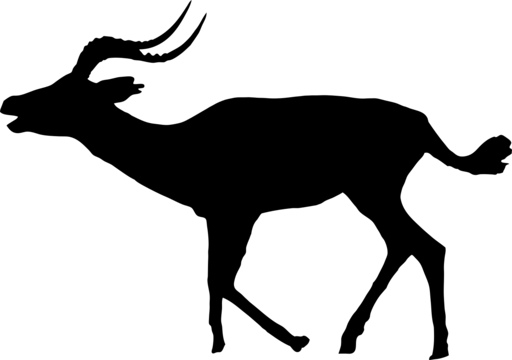
Tsessebe
Damaliscus lunatus
Silhouette: [unknown] · PhyloPic
- KingdomAnimalia (Animals)
- PhylumChordata (Chordates)
- ClassMammalia (Mammals)
- OrderArtiodactyla (Even-toed Ungulates and Cetaceans)
- FamilyBovidae (Bovids)
- GenusDamaliscus (Sassabies)
- SpeciesDamaliscus lunatus (Tsessebe)
About the Tsessebe
Damaliscus lunatus is a large African antelope of the genus Damaliscus and subfamily Alcelaphinae in the family Bovidae, with a number of recognised geographic subspecies. Some authorities have split the different populations of the species into different species, although this is seen as controversial. Common names include topi, sassaby (formerly also sassayby), tiang and tsessebe.
The word tope or topi is Swahili, and was first recorded by the German explorer Gustav Fischer on the ancient city island of Lamu off the Kenyan coast. Other names recorded in East Africa by various German explorers were mhili in Kisukuma and jimäla in Kinyamwezi. The Luganda name was simäla according to Neumann, or nemira according to Lugard.
The first thing published about this antelope was the afore-mentioned painting of a young male sassayby by Daniell from 1820, but the first scientific description was by William John Burchell in 1824. In 1812 hunters attached to Burchell's expedition shot a female animal in what is now Free State, in what is thought to be the southernmost part of its range. Burchell named it the "crescent-horned antelope", Antilope lunata. Burchell had... Wikipedia →
Recent sightings of Tsessebe in Kruger National Park
LIVEiNaturalistClosest Relatives at Kruger National Park

 Bontebok/Blesbok
Damaliscus pygargus

Impala
Aepyceros melampus

 African Buffalo
Syncerus caffer

 Greater Kudu
Tragelaphus strepsiceros

 Waterbuck
Kobus ellipsiprymnus

Blue Wildebeest
Connochaetes taurinus

Steenbok
Raphicerus campestris

Northern Bushbuck
Tragelaphus scriptus

 Nyala
Tragelaphus angasii

Klipspringer
Oreotragus oreotragus

 Bush Duiker
Sylvicapra grimmia

Sharpe's Grysbok
Raphicerus sharpei
Global Distribution
Warmer areas are where this animal is recorded most often.
Parks Where Found
| # | Park | Country | Daily sighting probability |
|---|---|---|---|
| 1 | Moremi Game Reserve | 🇧🇼 Botswana | |
| 2 | Pilanesberg National Park | 🇿🇦 South Africa | |
| 3 | Chobe National Park | 🇧🇼 Botswana | |
| 4 | Kruger National Park | 🇿🇦 South Africa | |
| 5 | iSimangaliso Wetland Park | 🇿🇦 South Africa | |
| 6 | Serengeti National Park | 🇹🇿 Tanzania | |
| 7 | Hwange National Park | 🇿🇼 Zimbabwe | |
| 8 | Akagera National Park | 🇷🇼 Rwanda | |
| 9 | Queen Elizabeth National Park | 🇺🇬 Uganda | |
| 10 | Masai Mara National Reserve | 🇰🇪 Kenya | |
| 11 | Tsavo East National Park | 🇰🇪 Kenya | |
| 12 | Etosha National Park | 🇳🇦 Namibia | |
| 13 | Virunga National Park | 🇨🇩 Democratic Republic of the Congo |
Quick answers
What are the chances of seeing a Tsessebe in Kruger National Park?
About 10% of wildlife watchers report a Tsessebe sighting in Kruger National Park, based on 115 verified sightings from GBIF citizen-science data.
When is the best time to see Tsessebe in Kruger National Park?
October has the highest sighting rate for Tsessebe in Kruger National Park in our monthly data.