

little big-eared bat
Micronycteris megalotis
Silhouette: Roberto Díaz Sibaja · PhyloPic
- KingdomAnimalia (Animals)
- PhylumChordata (Chordates)
- ClassMammalia (Mammals)
- OrderChiroptera (Bats)
- FamilyPhyllostomidae (New World Leaf-nosed Bats)
- GenusMicronycteris (Little Big-eared Bats)
- SpeciesMicronycteris megalotis (little big-eared bat)
About the little big-eared bat
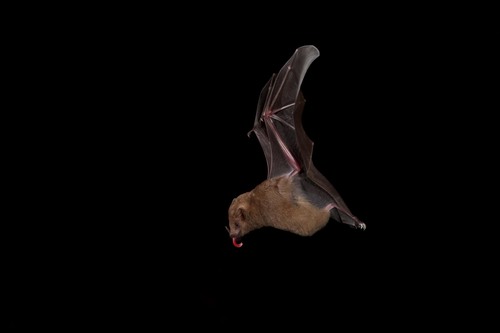
The little big-eared bat (Micronycteris megalotis) is a bat species in the order Chiroptera and family Phyllostomidae. It is from South and Central America particularly Colombia, Venezuela, Guyana, French Guiana, Brazil, Peru, Ecuador, Bolivia, Argentina, Paraguay, Suriname and Trinidad. Though its exact population is unknown, it is considered widespread and occurs in protected areas, although deforestation may be a minor threat, it is classified as Least Concern. It is found in multistratal evergreen forests and dry thorn forests and forages near streams and is found hollow trees, logs, caverns, or houses with groups up to twelve. The head and body length measures at 44 millimetres (1.7 in) for males and 45 millimetres (1.8 in) for females. Males usually weigh about 5 grams (0.18 oz) while females weigh 5.7 grams (0.20 oz).
Micronycteris megalotis is considered a small bat for its genus, although the size varies slightly depending on geographical location. It has large ears which are characteristic of its species. It has a large nose pad that is generally twice as high as it is wide. The head is elongated and eyes are small and black. M. megalotis has short wings... Wikipedia →
Recent sightings of little big-eared bat in Main Ridge Forest Reserve
LIVEiNaturalistClosest Relatives at Main Ridge Forest Reserve

 Jamaican Fruit-eating Bat
Artibeus jamaicensis
 Miller's long-tongued bat
Glossophaga longirostris

Flat-faced Fruit-eating Bat
Artibeus planirostris

 Seba's Short-tailed Bat
Carollia perspicillata

Geoffroy's tailless bat
Anoura geoffroyi

Gervais's Fruit Eating Bat
Artibeus cinereus

wrinkle-faced bat
Centurio senex

Hairy Big-eyed Bat
Chiroderma villosum
Great Fruit-eating Bat
Artibeus lituratus

Tilda Yellow-shouldered Bat
Sturnira tildae

 Attenborough's Myotis
Myotis attenboroughi

 Lesser Sac-winged Bat
Saccopteryx leptura
Global Distribution
Warmer areas are where this animal is recorded most often.
Parks Where Found
| # | Park | Country | Daily sighting probability |
|---|---|---|---|
| 1 | Main Ridge Forest Reserve | 🇹🇹 Trinidad and Tobago |
More parks will be added in future updates.