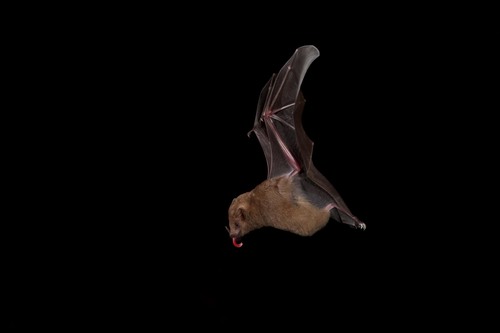

Miller's long-tongued bat
Glossophaga longirostris
Silhouette: Edwin Price · PhyloPic
- KingdomAnimalia (Animals)
- PhylumChordata (Chordates)
- ClassMammalia (Mammals)
- OrderChiroptera (Bats)
- FamilyPhyllostomidae (New World Leaf-nosed Bats)
- GenusGlossophaga (Long-tongued Bats)
- SpeciesGlossophaga longirostris (Miller's long-tongued bat)
About the Miller's long-tongued bat
Miller's long-tongued bat (Glossophaga longirostris) is a bat species found in northern Brazil, Venezuela, Colombia, Guyana, Trinidad and Tobago, Grenada, the Netherlands Antilles and the U.S. Virgin Islands. Miller's long-tongued bat was described as a new species in 1898 by American zoologist Gerrit Smith Miller Jr. The holotype had been collected in the Sierra Nevada de Santa Marta of Colombia by Wilmot W. Brown Jr. Six or seven subspecies are typically recognized.
Glossophaga species are small, with average forearm lengths ranging from 31–42 mm (1.2–1.7 in). Miller's long-tongued bat has a braincase that is equivalent in length to its snout, whereas other members of the genus have a shorter snout relative to the braincase. Its dental formula is 2.1.2.32.1.3.3 for a total of 34 teeth. Males weigh an average of 13.25 g (0.467 oz), while nonpregnant females weigh 12.81 g (0.452 oz).
Miller's long-tongued bat is nectarivorous, with cacti blossoms as an important food source. Two breeding seasons occur annually: December–April and June–October. The litter size is one pup. Miller's long-tongued bat is found in the... Wikipedia →
Recent sightings of Miller's long-tongued bat in Main Ridge Forest Reserve
LIVEiNaturalistClosest Relatives at Main Ridge Forest Reserve

 Jamaican Fruit-eating Bat
Artibeus jamaicensis

Flat-faced Fruit-eating Bat
Artibeus planirostris

 Seba's Short-tailed Bat
Carollia perspicillata

Geoffroy's tailless bat
Anoura geoffroyi

Gervais's Fruit Eating Bat
Artibeus cinereus

wrinkle-faced bat
Centurio senex

little big-eared bat
Micronycteris megalotis

Hairy Big-eyed Bat
Chiroderma villosum
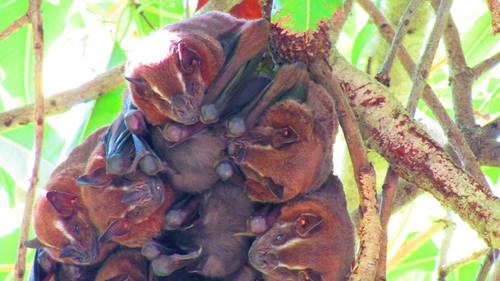
Great Fruit-eating Bat
Artibeus lituratus

Tilda Yellow-shouldered Bat
Sturnira tildae

 Attenborough's Myotis
Myotis attenboroughi

 Lesser Sac-winged Bat
Saccopteryx leptura
Global Distribution
Warmer areas are where this animal is recorded most often.
Parks Where Found
| # | Park | Country | Daily sighting probability |
|---|---|---|---|
| 1 | Main Ridge Forest Reserve | 🇹🇹 Trinidad and Tobago |
More parks will be added in future updates.