


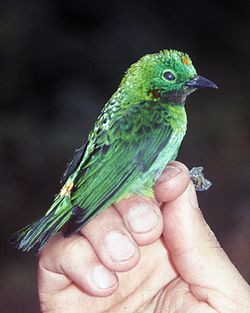

Orange-eared Tanager
Chlorochrysa calliparaea
Silhouette: Sheatherius · PhyloPic
- KingdomAnimalia (Animals)
- PhylumChordata (Chordates)
- ClassAves (Birds)
- OrderPasseriformes (Perching Birds)
- FamilyThraupidae (Tanagers and Allies)
- GenusChlorochrysa (Chlorochrysa Tanagers)
- SpeciesChlorochrysa calliparaea (Orange-eared Tanager)
About the Orange-eared Tanager
The orange-eared tanager (Chlorochrysa calliparaea) is a species of bird in the family Thraupidae. It is found in Bolivia, Colombia, Ecuador, Peru, and Venezuela. Its natural habitat is subtropical or tropical moist montane forests. Wikipedia →
Recent sightings of Orange-eared Tanager in Manu National Park
LIVEiNaturalistClosest Relatives at Manu National Park

 Silver-beaked Tanager
Ramphocelus carbo

Blue-gray Tanager
Thraupis episcopus

Buff-throated Saltator
Saltator maximus

Blue-necked Tanager
Stilpnia cyanicollis

Paradise Tanager
Tangara chilensis

Palm Tanager
Thraupis palmarum

Red-capped Cardinal
Paroaria gularis

Magpie Tanager
Cissopis leverianus

Swallow Tanager
Tersina viridis

 Bananaquit
Coereba flaveola

Saffron-crowned Tanager
Tangara xanthocephala

Turquoise Tanager
Tangara mexicana
Global Distribution
Warmer areas are where this animal is recorded most often.
Parks Where Found
| # | Park | Country | Daily sighting probability |
|---|---|---|---|
| 1 | Podocarpus National Park | 🇪🇨 Ecuador | |
| 2 | Cordillera Azul National Park | 🇵🇪 Peru | |
| 3 | Manu National Park | 🇵🇪 Peru | |
| 4 | Chingaza National Natural Park | 🇨🇴 Colombia | |
| 5 | Madidi National Park | 🇧🇴 Bolivia | |
| 6 | Puracé National Natural Park | 🇨🇴 Colombia |
Quick answers
What are the chances of seeing a Orange-eared Tanager in Manu National Park?
About 10% of wildlife watchers report a Orange-eared Tanager sighting in Manu National Park, based on 705 verified sightings from GBIF citizen-science data.
When is the best time to see Orange-eared Tanager in Manu National Park?
March has the highest sighting rate for Orange-eared Tanager in Manu National Park in our monthly data.