


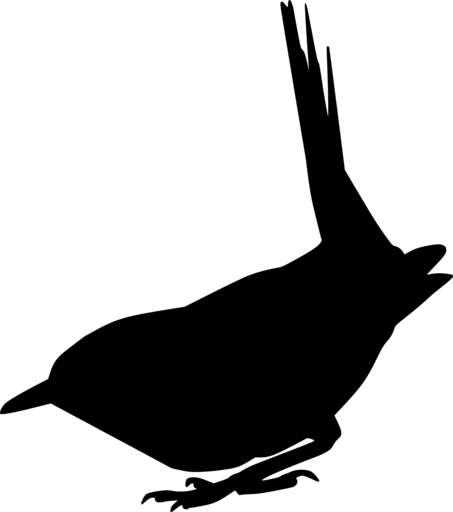
House Wren
Troglodytes aedon
Silhouette: Edwin Price · PhyloPic
- KingdomAnimalia (Animals)
- PhylumChordata (Chordates)
- ClassAves (Birds)
- OrderPasseriformes (Perching Birds)
- FamilyTroglodytidae (Wrens)
- GenusTroglodytes (Troglodytes Wrens)
- SpeciesTroglodytes aedon (House Wren)
About the House Wren
The northern house wren (Troglodytes aedon) is a very small passerine in the wren family Troglodytidae. It is found in southern Canada, the USA and Mexico. It occurs in most suburban areas in its range. It formerly included many subspecies resident in South America and in the Caribbean that are now considered as separate species. The name troglodytes means "hole dweller", and is a reference to the bird's tendency to disappear into crevices when hunting insects or to seek shelter.
The northern house wren was formally described in 1809 by the French ornithologist Louis Pierre Vieillot under the current binomial name Troglodytes aedon. The specific epithet is from the Ancient Greek aēdōn meaning "nightingale". The type locality was designated as New York City by Harry Oberholser in 1934. An earlier specific name, domestica in the combination Sylvia domestica, was introduced in 1808 by the American ornithologist Alexander Wilson. This was rarely used and in 1998 to conserve the widely used name aedon, the International Commission on Zoological Nomenclature suppressed the specific name domestica for the purposes of the principle of priority.
Four subspecies are recognised... Wikipedia →
Recent sightings of House Wren in Reserva de la Biosfera Mariposa Monarca
LIVEiNaturalistClosest Relatives at Reserva de la Biosfera Mariposa Monarca

 Bewick's Wren
Thryomanes bewickii

 Spotted Wren
Campylorhynchus gularis

Canyon Wren
Catherpes mexicanus

Gray-barred Wren
Campylorhynchus megalopterus

Gray-breasted Wood-Wren
Henicorhina leucophrys

 Yellow-eyed Junco
Junco phaeonotus

 Ruby-crowned Kinglet
Regulus calendula

 House Finch
Haemorhous mexicanus

 Slate-throated Redstart
Myioborus miniatus

 Yellow-rumped Warbler
Setophaga coronata

 Townsend's Warbler
Setophaga townsendi

 Red Warbler
Cardellina rubra
Global Distribution
Warmer areas are where this animal is recorded most often.
Parks Where Found
| # | Park | Country | Daily sighting probability |
|---|---|---|---|
| 1 | Point Pelee National Park | 🇨🇦 Canada | |
| 2 | Reserva de la Biosfera Mariposa Monarca | 🇲🇽 Mexico | |
| 3 | Cabo Pulmo National Park | 🇲🇽 Mexico | |
| 4 | Yosemite National Park | 🇺🇸 United States | |
| 5 | Big Cypress National Preserve | 🇺🇸 United States | |
| 6 | Everglades National Park | 🇺🇸 United States | |
| 7 | Shenandoah National Park | 🇺🇸 United States | |
| 8 | El Vizcaíno Biosphere Reserve | 🇲🇽 Mexico | |
| 9 | Congaree National Park | 🇺🇸 United States | |
| 10 | Bahía de Loreto National Park | 🇲🇽 Mexico | |
| 11 | Saguaro National Park | 🇺🇸 United States | |
| 12 | Joshua Tree National Park | 🇺🇸 United States | |
| 13 | Acadia National Park | 🇺🇸 United States | |
| 14 | Isle Royale National Park | 🇺🇸 United States |
Quick answers
What are the chances of seeing a House Wren in Reserva de la Biosfera Mariposa Monarca?
About 30% of wildlife watchers report a House Wren sighting in Reserva de la Biosfera Mariposa Monarca, based on 63 verified sightings from GBIF citizen-science data.
When is the best time to see House Wren in Reserva de la Biosfera Mariposa Monarca?
December has the highest sighting rate for House Wren in Reserva de la Biosfera Mariposa Monarca in our monthly data.